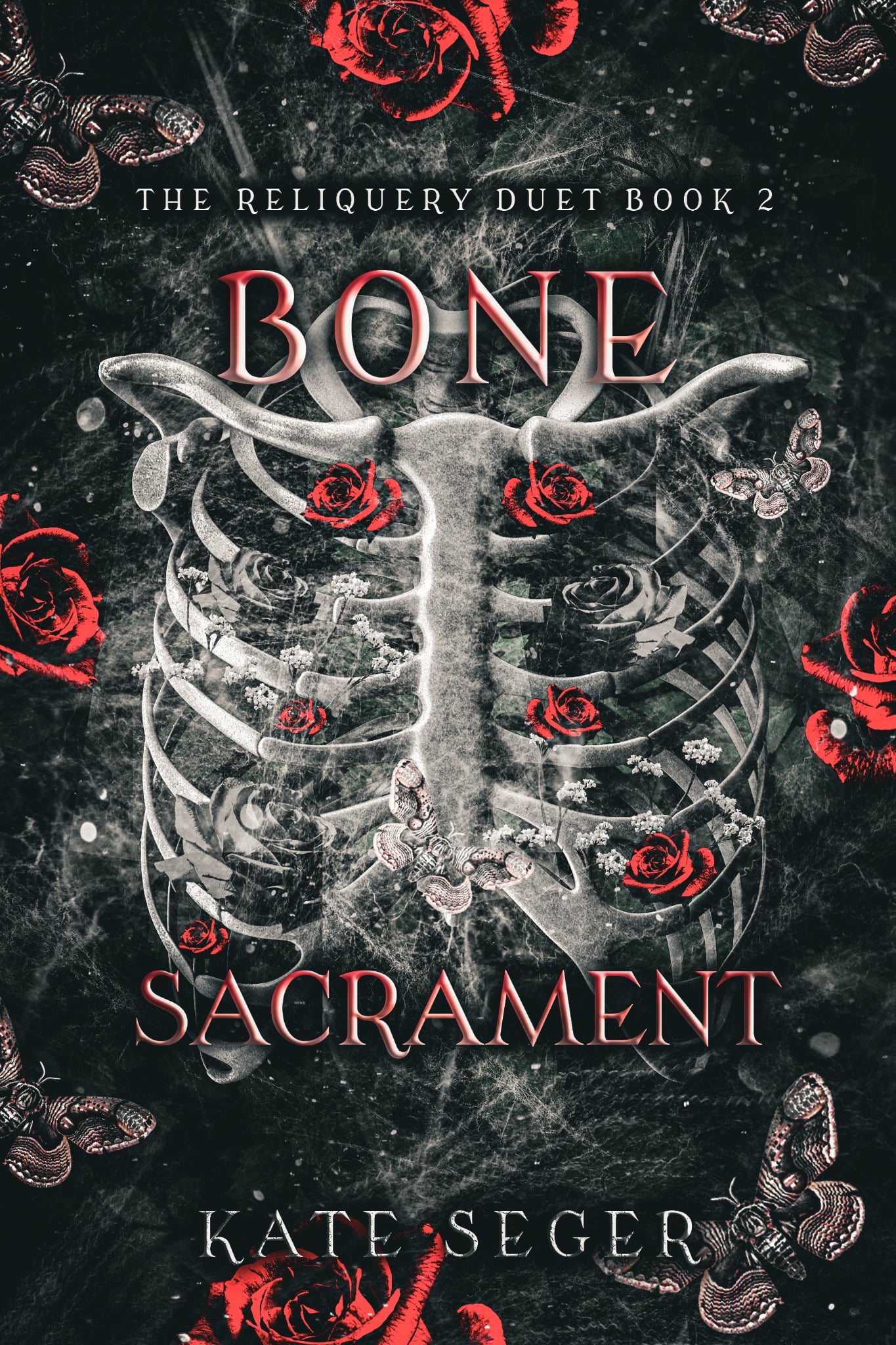
KATE SEGER
THE BEAST
BENEATH THE BELLS

London, 1888. Cordelia Prosser is a manuscript conservator who touches damaged things for a living — restoring what's been burned, warped, half-erased. The diary she's been working on in her Bermondsey lab is fire-marked, provenance unknown, dated 1888. When the ink begins to move, she doesn't have time to be surprised.
She arrives in October, during the Whitechapel murders, with nothing from her own century but the clothes on her back and the half-restored diary in her hands. The city is all sulfur-yellow fog and the particular weight of a place that knows something is wrong and won't say what.
Beneath Blackfriars Bridge, chained for forty years by a man's grief, is Sunder: an ancient Thames Guardian made of horn and stone and river-born strength, his body scarred by iron, his voice cracked from decades of disuse. He holds the boundary between worlds. He is slowly being consumed by the thing that holds him.
For the things that were put in chains to keep the world together.
And for the ones who decided that wasn’t enough of a reason.
A restricted scholarly document — the unofficial compendium of the London Troth and its attendant phenomena. The Codex describes the membrane between worlds, the binding that holds Sunder, and the rules of a city that has always kept its oldest secrets beneath the waterline.
Open the Codex →A note from the fog
Halfway through writing Else, The Beast Beneath the Bells arrived without warning. That is the only honest description of it. I was in Ashenmere, in 1348, and then I was under Blackfriars Bridge in 1888, and a man made of river-stone and forty years of silence was looking at me through the page.
Sunder was not a character I designed. He arrived as a fact: ancient, enormous, chained. The circumstances of his binding — Hadleigh Wren, grief twisted into desperate magic, forty years and counting — came later. But Sunder himself arrived whole. The horns. The voice like gravel in a current. The particular patience of something that has been waiting so long it has stopped counting the days.
Cordelia arrived because Sunder needed someone who understood damaged things. That is what she does: she takes what has been burned or warped or half-erased and coaxes it back toward what it was. The diary chose her for that reason. I think Sunder would have agreed with the diary’s logic, if anyone had asked him.
This book lives in a city that is fraying at its edges. The Troth — the membrane between the human world and the older, wilder currents beneath it — is held together by beings like Sunder, who give everything they are to the keeping of it. The Fraying, when it comes, starts as a slow wrongness: shadows that lengthen past where they should, the Thames smelling of something that has no name. By the time it becomes visible, it has already been happening for a long time.
Cordelia is not supposed to be able to fix it. Neither is she supposed to care this much about the thing beneath the bridge. Neither of those facts stops her.
More in the Codex, for those who want to know the rules of a world that runs on old compacts and older grief. And if you want to know how the binding worked — if you want to understand what Wren did and why it is unraveling — the diary knows more than Cordelia does at first.
The Blackfriars Codex
An Unofficial Compendium of the London Troth
and its Attendant Phenomena
Unauthorised duplication or dissemination carries grave spiritual and temporal risks.
I. THE UNSEEN HEART OF THE CITY
London, in its ceaseless expansion and grimy grandeur, conceals an older, more potent truth beneath its cobbled streets and gaslit fog. It is a city built upon layers not merely of brick and rumour, but of ancient compacts and living thresholds, a sacred geography that predates Roman legions and Norman kings. Understand this: the world you perceive is not the only one, and London is less a city and more a living membrane stretched taut between realities. To ignore this is to invite oblivion.
II. THE TROTH: A LIVING COMPACT
At its core, the Troth is the primary boundary between the human world and the wilder, older currents of existence. It is not a wall, but a membrane, porous and breathing, anchored at specific points across the city. When the Troth holds firm, the two worlds remain distinct, their influences bleeding only in measured, manageable drips: a sudden chill in a sunlit room, a fleeting scent of something that never existed, a whisper carried on a windless night.
The Troth draws its strength from the specific energies of London itself: the deep flow of the Thames, the resonance of its bells, the solemnity of its churchyards, the weight of history in its ancient stones. These are not merely landmarks; they are anchors, points of intense spiritual pressure where the boundary is thinnest and most vulnerable, or, conversely, strongest.
III. THE GUARDIANS
To maintain this delicate balance, the Troth requires Guardians — entities of ancient, non-human provenance, bound to specific anchors. Their purpose is singular: to hold the boundary, to channel its energies, and to prevent its collapse. A Guardian is not merely a watchman; they are a living conduit, their essence intertwined with the very fabric of the Troth.
When a Guardian is weakened, corrupted, or forcibly removed from their post, the Troth begins to fray. This Fraying is a slow, insidious process, a dissolution of the membrane. And if the Fraying progresses unchecked, the world begins to Unravel.
IV. BLACKFRIARS BRIDGE: THE CHAINED HEART
This bridge, a marvel of Victorian engineering, sits atop one of London’s most vital Troth anchors. Beneath its arches, where the river runs deep and the current churns with a restless energy, the boundary is thinnest. For the past forty years, it has been the site of a profound tragedy and a potent binding: the ancient Thames Guardian, a creature of horn and stone and river-born strength, known in whispers as Sunder, has been chained here.
His presence, even in captivity, channels and stabilises a critical section of the Troth. His anguish, however, seeps into the river’s heart, a heavy, potent sorrow that makes the air beneath the bridge thick and suffocatingly close. The very stone of the bridge seems to hum with the tension of his confinement, a low, guttural vibration that can be felt in the soles of one’s feet. It is a place of immense power, and immense suffering.
V. THE RULES OF THE TROTH
- The Fraying. When a Guardian’s binding falters, the Troth begins to thin. Inexplicable fogs, unnatural chills, objects moving on their own, the sudden appearance of impossible creatures in the periphery. These are not malicious acts, but symptomatic bleed-throughs from the other side.
- The Unraveling. If the Fraying continues, the membrane can tear completely. The boundaries between worlds dissolve. The fabric of reality begins to tear. London, and by extension, the world, would cease to be.
- Binding Rituals. Certain occultists possess the knowledge to bind ancient spirits and even Guardians. Hadleigh Wren’s forty-year binding of Sunder was driven by a grief so potent it twisted his arcane knowledge into a desperate, selfish act — not for the Troth’s preservation, but for his own twisted ends. Such bindings are inherently corruptive to the bound entity.
- Memory and Connection. A Guardian’s ability to recall a specific name, a touch, or a shared moment — particularly across the chasms of time — suggests a deeper connection that can transcend even the most powerful bindings. This connection can act as both a vulnerability and an unexpected source of strength, capable of re-awakening dormant aspects of a Guardian’s true nature.
- Diary-Bound Travel. Certain artefacts, saturated with the desires, sorrows, and unresolved energies of their creators, can become conduits between worlds and across time. Travel through such means is rarely precise and always carries the risk of unforeseen displacement — or worse, being lost between the membranes of reality.
Where it begins
The pothos back in her flat was not dead yet.
Cordelia checked the photo on her phone for the third time that afternoon, tilting the screen against the lab’s fluorescent glare. The plant sat on her windowsill in Bermondsey, pale green, its single new leaf unfurling toward the light. Three weeks she’d kept it. Longer than the basil. Longer than the fern Marcus had given her after the funeral, which turned brown in six days, as if it could smell the flat and wanted no part of it.
She set the phone face down and returned to the manuscript. A seventeenth-century psalter, water-damaged along the gutter, the vellum stiff and warped. She’d been humidifying it since morning: damp blotting paper, a layer of Gore-Tex, the slow coaxing of the fibres back to pliancy.
The diary on the corner of her bench was different. No provenance. Fire-marked. Dated 1888 in the estate clearance notes, which was all anyone had thought to write down. She’d been putting off opening it properly for a week.
She reached for it now.