K.S. VALENTINA
BRIGHTWATER
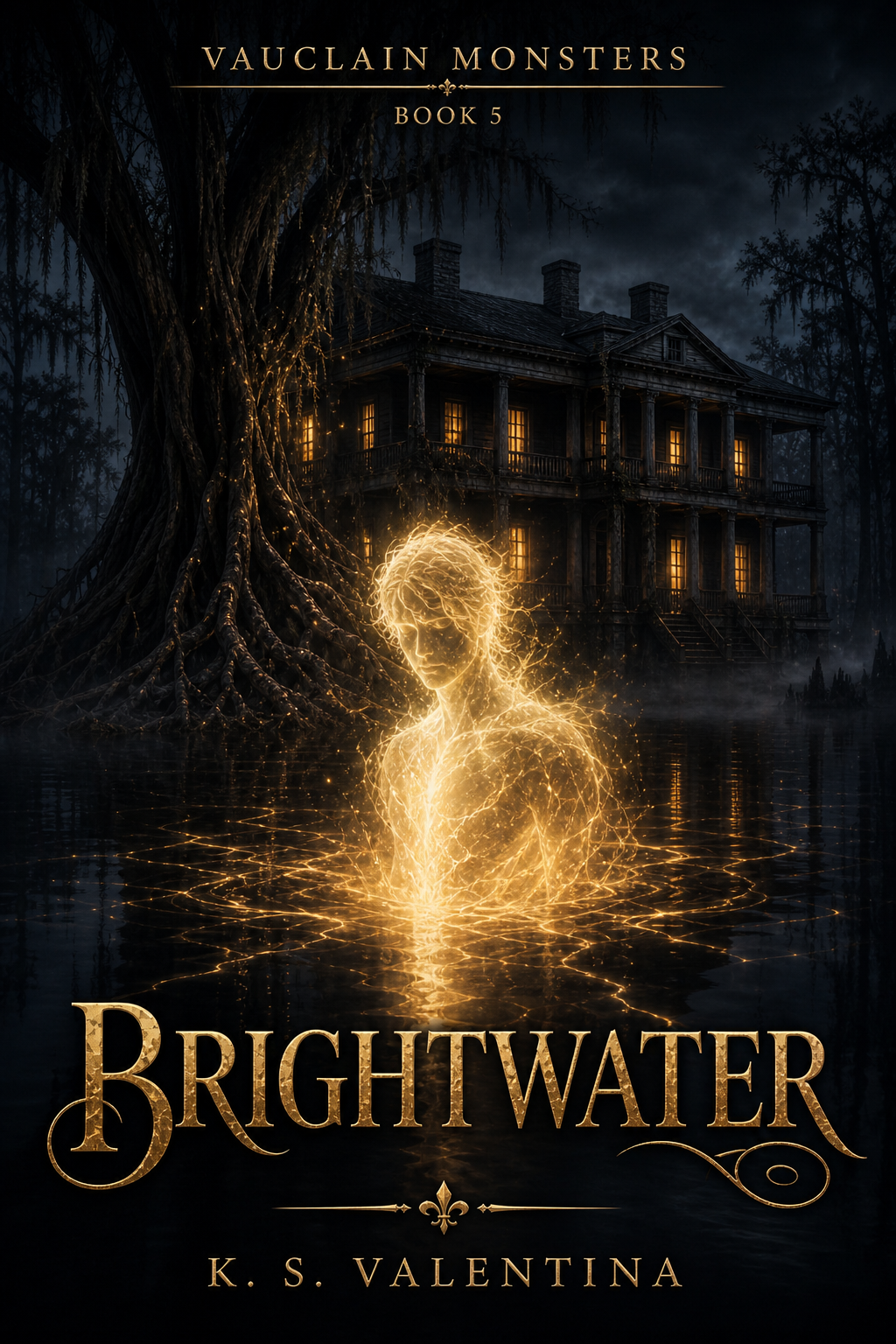
I paid fifteen years of my life to save the man in the channel.
I would do it again. That isn’t the problem.
The problem is what the trade gave back.
Feu has always been the light at the edge of the Hollow. The amber flicker at the tree line. The thing you are never supposed to follow. He spent seven months leading danger away from me before I knew enough to thank him for it, and I am still not comfortable with how much that matters.
Now he has hands.
Sometimes.
Thirty seconds at dusk. Forty-five by the end of the week. Long enough to touch me. Not long enough to stay.
The door opening for him is not like Leste’s. Water has rules. The channel has weight. Feu is light, wanting shape, and the covenant has never been generous with wanting.
I have a tremor now. Gray at my temples. A house watching from the kitchen window. A rougarou at the fence. A man in the water who knows exactly what fifteen years cost. And a will-o’-wisp sitting beside me at the bench, becoming real by increments I do not have a budget for.
I’m still a science teacher from Ohio. I still write everything down.
But I am beginning to understand that some lights don’t lure you into the dark.
Some lights have been keeping the dark from finding you.
A note from the property
Brightwater is the summer book. The one I have been writing toward since the porch first appeared on the page in Boundwater and the fourth room first refused to open. The household has been ready for it for one hundred and seventy-eight Mays. Feu has been ready for it for longer.
Della is the one who isn’t.
She paid fifteen years of her life to save Leste from the channel, and the channel took the fifteen years from her body the way the covenant takes things — quietly, without an itemized receipt. She has a tremor now. Her knees finish before noon. There is gray at her temples that wasn’t there a year ago. And the door at the back of the house is opening anyway, on its own schedule, because Feu was always going to come into the light when the household could hold him in it.
This book is the one where the cost of the holding becomes a number she can read. Where the covenant stops asking and starts answering. Where the four are no longer four monsters at the fence and become a household at the table, with a fifth plate set down and a man at the porch railing waiting to be chosen in the summer light.
I’ve put two pieces of bonus content below for the readers who follow this work. A primer on the Louisiana feu follet folklore that built Feu, for the new readers and the ones who like the field notes. And — for the readers who follow both series — a deeper history of the Frostwoven line from the Iron Vow Society. Lysander’s family. The ice-builders. The thousand-year working.
Brightwater is on preorder. The next book — the last book — is being written.
The Feu Follet of Louisiana
On the swamp light, the fool’s fire, and where Feu came from.
In the wetland country south of Baton Rouge, where the cypress stand in standing water and the air at dusk thickens into a thing you walk through rather than breathe, the Cajun-speaking French and Creole settlers brought a word with them out of the old country and gave it back to the swamp: feu follet. Foolish fire. The light that follows you home and is not a candle.
It has other names in other tongues. In English you would call it a will-o’-the-wisp. In Latin the old natural philosophers called it ignis fatuus — fatuous fire, idiot flame. In the Cajun dialect of the bayou country it softens into fifolet, the syllables eaten the way Louisiana French eats syllables, an inheritance worn thin by humidity and time.
The folklore is older than the parish lines. A small light, sometimes blue, sometimes a soft phosphor-green, drifting across the marsh at the edge of vision. If you watch it, it moves. If you follow it, it goes deeper. The travelers who chase the feu follet are pulled into the standing water and not found.
The bayou-folk had several explanations for what the light was, depending on the household. It was the soul of an unbaptized child, kept out of heaven by an accident of timing, kept out of hell by an accident of innocence, walking the swamp because there was nowhere else to walk. It was a man who had died unconfessed, his sin still on him, the light the last warmth his body remembered. It was a witch’s lantern — a person living, but practiced, who could send her own light out from her body to wander the parish at night and report back what it saw.
The protections were as folk-Catholic as the explanations. If the light approached, you turned your shirt inside out. You drove a knife into the wet ground at your feet — the iron held the light. You did not speak its name, and you did not call to it. You did not, under any circumstance, follow.
The scientific explanation arrived later and was unkind to the imagination. Methane and phosphine, off-gassing from rotting plant matter at the bottom of the swamp, igniting spontaneously when they hit the warmer air at the surface. A blue flame, briefly. A bioluminescent cousin of the same chemistry. The light is real. The light is also just gas.
Both can be true. The folklore did not die because the chemistry arrived. The folklore went into the houses with the families and stayed there, in the way of the things people keep without knowing they are keeping them. The grandmothers told it. The fathers warned about it on the way home from town. The children walked closer to the road at dusk.
The feu follet is the bayou’s first answer to the question of what to do with the dead who are still nearby. Not gone. Not arrived. Visible at dusk. Light without the body it used to belong to.
I took the folklore and gave it a person. Feu, in the Vauclain books, is not a metaphor for the feu follet — he is the folklore made into a man who was once a man and is now what the binding kept of him. He is the brief light at dusk. He is the one waiting at the bench because the house was built around his refusal to leave. He was made for the first light, the briefest light, the light that arrives before anyone can use it.
The Vauclain household has five plates at the table for a reason. The fourth room is dark for a reason. Both reasons come from the same old story the grandmothers told at the back porch, with a knife in the rail and a shirt turned inside out.
If you have walked the bayou at dusk and seen the light, the old families would tell you: do not follow.
In Brightwater, Della follows.
✦ ✦ ✦
The Frostwoven Line
For the readers who follow both series — Lysander’s family, in full.
A thousand years before Study in Scarlett opens, the Iron Vow was signed by five families. Four of them are remembered for what they did to the Null Enforcers. The fifth is remembered for the ice.
The Frostwoven were ward-architects. Frost-workers. They did not enforce the Vow with armies the way the Ashworths did, or by political maneuver the way the Locke line did before it was scrubbed from the ledger. The Frostwoven built. They put a single signature on the document — Aurelius von Frostwoven — and then they went home and began layering ice into walls.
The estate stands one hundred and twenty-seven miles from the Obsidian Marrow mountain, in the border territories where the air is cold enough year-round to hold the lattice work without seasonal collapse. Eleven generations have added to it. The clearing at the property line runs twenty degrees below the surrounding ambient — a temperature the instruments find first, then the chest finds a few seconds after, then the body’s slower clocks find last as a recognition: this household is older than the road that found it.
The walls were carved by Ilara Frostwoven, Lysander’s grandmother. She was a mathematician before she was a matriarch. The walls of the Frostwoven estate are her notebooks scaled up to architecture — her lattice designs, scored into the ice, holding the household together by a working she never wrote out in conventional notation because conventional notation could not carry it.
Ilara is the part of the family history the ledger does not keep. She spent the last forty years of her life trying to reach the consciousness inside the Obsidian Marrow mountain — the entity the older texts call Syth — by pressing her palm to the lower corridor wall of the estate and broadcasting the Frostwoven signature into the stone. She did not receive a reply during her lifetime. The mountain felt her, the histories now suggest, and could not answer in any vocabulary she would have understood. The mountain ran heat through her corridor and waited.
And Ilara did the other thing she is not remembered for. She collaborated, across the political distance of two warring families, with Cerise Locke — Scarlett’s grandmother. A Null. A woman whose magic was a void where the Frostwoven magic was a structure. The two of them, working in secret, designed the complete six-academy reversal lattice that the Iron Vow was eventually built to prevent. Ilara wrote in frost-notation on vellum. Cerise wrote in void-script in the negative space of Ilara’s pages. Each layer was meaningless without the other. Together — the working.
It would have anchored the world. It needed three anchors. Cerise could only find two. Ilara understood what that meant — that the third would arrive generations later — and she locked the complete proof in the family vault, on the lowest level, behind an obsidian door that requires ninety seconds of sustained base-frost to open.
The margin note on the last page is the line that ends the proof:
the working is the proof that the loving was real
Alalia Frostwoven inherited the vault key and the family discipline. She is the one with the gray eyes and the calculation that reads, at first meeting, as the absence of warmth. She called Scarlett a biological defect at the Silver Solstice ball in Study in Scarlett, and she meant it the way a frost-worker means a structural assessment. She also wrote a letter to her son when he was eighteen telling him that his frost was his own, that nothing in the vault would change that, that she had failed him but he was still her son. The family courier, who answers to her husband, intercepted the letter. Alalia believed for eighteen years that her son had chosen not to answer.
What the Frostwoven family has done across four books is what the family was always going to do. The thing the household does best is hold a working through time. Ilara held her proof through her death. Alalia held the vault key through her son’s exile. The estate holds the lattice through eleven generations of frost. The cost the family pays for the holding is private, and the cost compounds.
Lysander is the third anchor. The mathematician who extends the proof. The arm that pays the vault’s price. The forty-third line of notation that lets the working close. He is, by the family’s own framework, the success of the Frostwoven discipline — the line concluding its thousand-year argument with itself.
What the family does not know how to do — what no Frostwoven before him has done — is acknowledge the cost of the holding out loud.
In a vocabulary the family ledger has no column for. On ground the family does not recognize.
That is the work of the next book.
⁂