K.S. VALENTINA
FLOTSAM
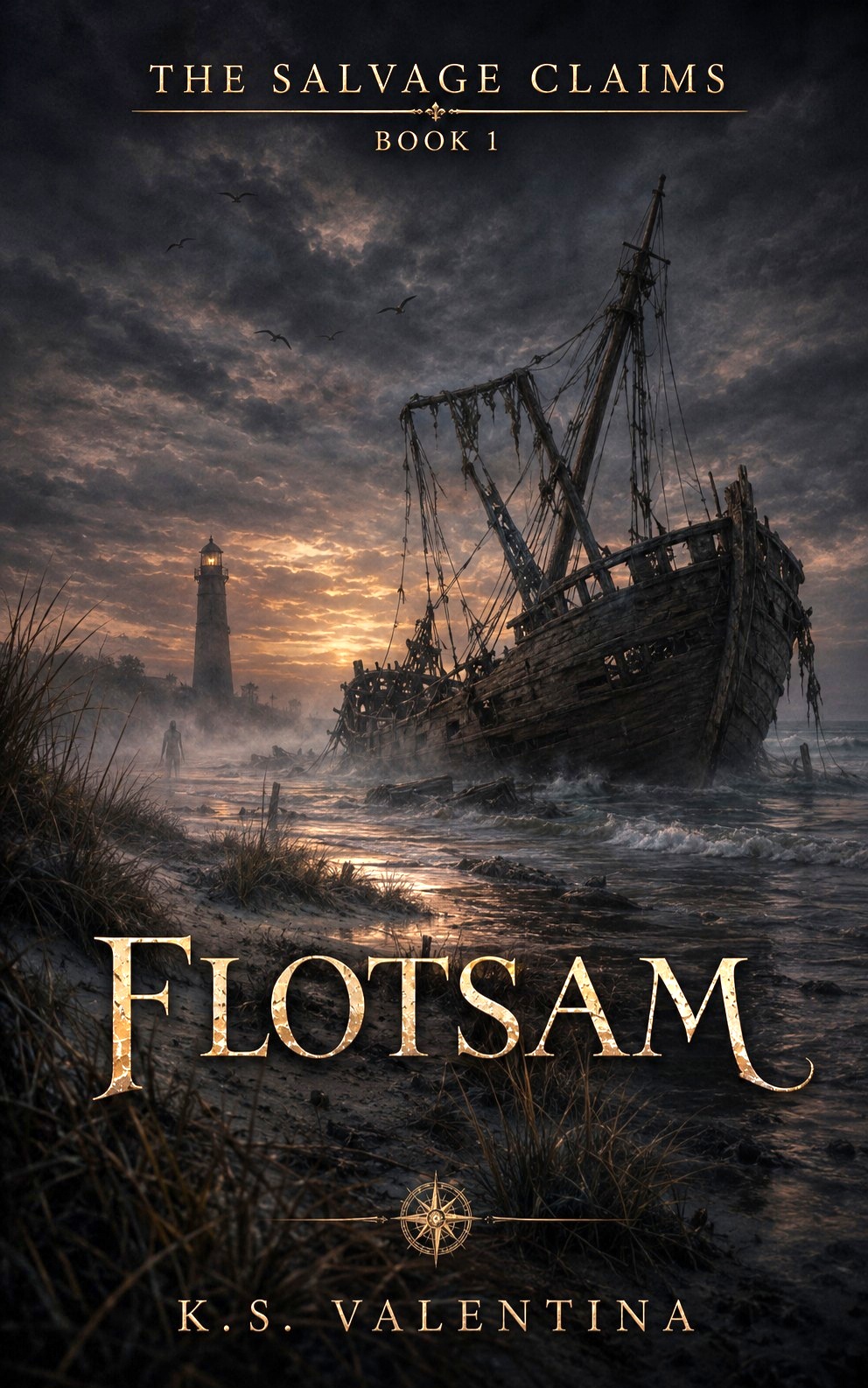
I came home to bury my great-aunt. I priced the whole island by the time the funeral ended.
Old habit. Appraiser’s eye. The trade I never meant to bring back with me.
Then the ferry broke down. Then the bridge closed. Then I noticed I hadn’t left.
Cane’s Folly has kept the same debt on its books for two hundred years, and the four things the sea sent to collect it have never once managed to close the file. They’ve been standing at the fence, in the marsh, on the road, at my own dock — waiting on a family that kept thinning out before any of them ever had to try very hard.
I’m the last Cane.
The water’s done waiting.
Some debts don’t forgive. They just wait for the right collector.
A note from the property
Flotsam is out in the world. It went live on July 27th, and for four days now readers have been walking onto Cane’s Folly, meeting the four, and sending me messages I am not emotionally equipped to discuss. Thank you. A launch is a strange tide. You made this one come in high.
If you’ve finished it already — first, my condolences about the last chapter; second, a review, even two sentences long, is the single most useful thing a reader can give a book in its first weeks. The island keeps its ledgers. So does the algorithm.
This issue is a release-day gift, in two halves. Below, for everyone who’s read even the first act: an original scene from twelve years before the book begins — the night Savannah left, told from the side of the two who stayed. And at the bottom, for everyone: the first word of what I’m building next, in a hollow very far from salt water, where the debts are older than the maps that stopped naming them.
The Salt Beds
Cane’s Folly, August 2014 — twelve years before Flotsam begins. Tildy Cane has just watched her great-niece drive for the ferry landing with everything she owns in the truck bed. Best read after Flotsam’s first act, though it spoils nothing you won’t want spoiled.
The taillights made the bend by the Dupree place and were gone, and Tildy Cane stood on her porch and listened to the engine fade under the sound of the tide going out, and when she could not tell one from the other anymore she went inside and put the kettle on.
She did not watch the road. Watching a road could look like doubt, and doubt carried. Sound traveled over water; everybody knew that. Fewer people remembered that wanting did too.
The kettle took its time. She used it. Cloth over the bread, supper plate washed and racked, the girl’s chair pushed in square to the table where it would stay pushed in now. Her hands did the evening the same as any evening, because the house was listening and the marsh was listening and the horseshoe of salt water around this island had been listening for two hundred years, and the message tonight needed to be: nothing has changed here. Nothing worth attention has left. Go on about your business.
Eighteen years old. A truck with a bad clutch and a good engine, a duffel, a dive certification, and a temper. Tildy had checked the tide table twice and picked the sailing herself — the 6:40, a falling tide, the water’s back turned while it minded its own leaving.
The kettle went. She made the tea and did not drink it. Then she took the coffee can of coarse salt down from the shelf over the stove and began the beds.
Every sill in the house had its channel — worn shallow troughs in the old heart pine, cut by nothing but this, sixty years of pouring and sweeping and pouring again, her mother’s hands before hers. Not lines. Lines were for people who did the thing once a year and hoped. These were beds, and beds you tended. She drew the salt down each channel in a slow ribbon, tamped it level with two fingers, and moved on. Kitchen. Hall. The girl’s room, which she did not stop in, and did the sill, and left.
Parlor last. That was the order. It had always been the order, and she’d stopped asking why around the time she’d stopped asking her mother most things, which was to say too early, which was a lesson she had passed on whole to another stubborn girl without meaning to.
Outside the parlor window, an inch past the screen, the dark was standing where it always stood.
You’d miss it if you hadn’t spent a lifetime learning the difference between dark and occupied dark. Tildy didn’t look at it straight on. That was manners. You didn’t stare at a neighbor over the fence just because you knew she was there.
“Evening,” Tildy said, and finished the sill.
The dark said nothing. It never had, in sixty years. But warmth came through the screen, a coin of it, and settled at the base of Tildy’s throat, and sat there like a hand that wasn’t one.
“She got the 6:40.” Tildy tamped the bed level and set the can down. “Falling tide.”
The warmth stayed. Down on the flats the fiddlers were going, thousands of small dry clicks, and beneath that the long pull of water finding its way back out of the grass. A working sound. The island doing its books for the night.
“I know you saw her go.” Tildy said it to the sill, to her own hands. “Whole town saw her go and looked somewhere else while they did it. They’re good at that. Two hundred years of practice at watching a thing around the edges.” She folded the cloth she wiped the sills with, corner to corner, and again. “You’re the only one who watches her straight, I think. Always did. She slept easiest the nights you kept her window, did you know that? Since she was small. Not one bad dream on an occupied night, and I kept count. I never once salted you out of that room, and don’t think I don’t know you never once needed the gap I left.”
The warmth at her throat pulsed. Once. Slow. If it was an answer, it wasn’t in a language with words in it, and Tildy had long ago stopped insulting them both by pretending she could translate.
“Here’s what I’ll say tonight, and then I’ll say goodnight.” Tildy straightened up. Her back had opinions about the sills these days; she had opinions about her back. “Everything on this island gets kept. That’s the trouble with the place, and I’ve made my peace with the trouble — I’m kept too, and it’s a bed I made fine for myself, and an old woman keeping a house and a hope isn’t a story anybody needs to cry over.” She looked at the occupied dark then, straight on, one time, the courtesy of a lifetime spent not doing it. “But that girl is going to be the first thing in two hundred years that gets away clean. And you’re going to let the wanting-her-back go through you and past you and out the other side, same as I do, every evening of my life. That’s the work now. That’s both our work.”
The dark held still, an inch from the screen, and held still in a manner that had nothing casual left in it.
“Goodnight, then,” Tildy said.
The warmth lifted from her throat slow, taking its time along her jaw, the exact path a thumb would take if a thumb were saying I heard you, and then the dark outside the window was only dark, and the fiddlers filled the quiet where it had stood.
Tildy put the salt can back over the stove. She sat at the table with the cold tea and the pushed-in chair, and after a while she took down the tablet of lined paper and the pen from the drawer where the string and the fuses lived, and she wrote the date, and then Dear Renee, and then she sat with her hand still for a long stretch of the tide.
The tide turned. Out past the fence line, the water started its slow walk back toward the house, in no hurry, missing nothing, the same as every night. On its way in it passed over the flats, the oyster rakes, the drowned old fields — all the things it had already collected, and kept, and would keep.
Tildy wrote: She’s away clean, Renee. Now we find out what it cost.
She read it over twice. Then she folded it into the drawer with the others nobody would read for twelve years, banked the salt bed on the kitchen sill a finger higher than usual, turned off the porch light, and left the one in the window burning — the one that said, to anything doing its arithmetic out there in the moving dark: occupied. Tended. Not yours.
⁂
From the letter
Issue No. 09 of The Sinner’s Syllabus carries a companion piece that isn’t on this page: “Seen and Spared” — the true two-hundred-year-old folklore of the Gray Man of the Carolina coast, the storm ghost the legend says you should hope to meet, and how he became Verey.
The letter is where the bonus pieces land first, and where some of them stay. If you’d rather not check a website to find out what the property is doing —