K.S. VALENTINA
FLOTSAM
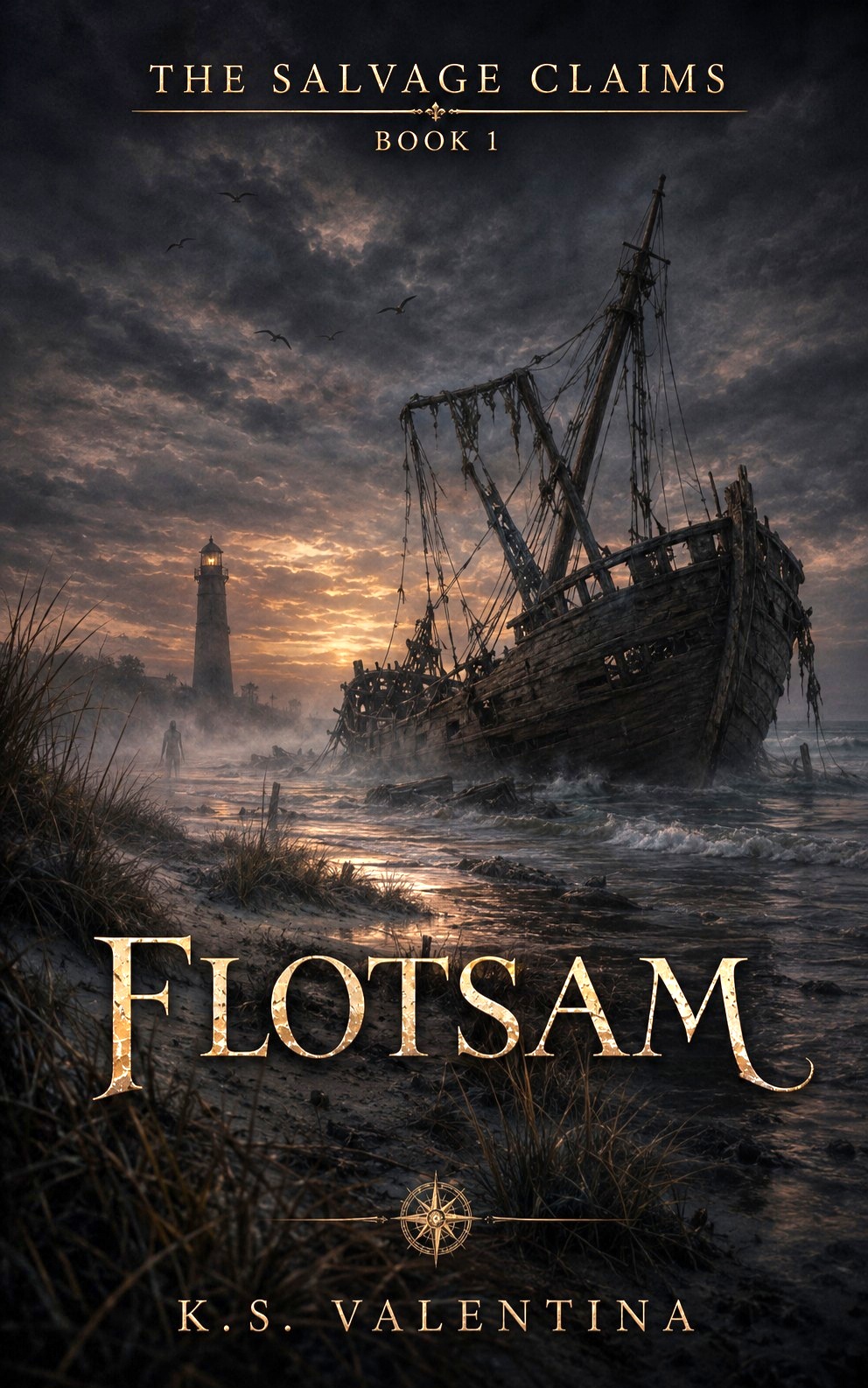
I came home to bury my great-aunt. I priced the whole island by the time the funeral ended.
Old habit. Appraiser’s eye. The trade I never meant to bring back with me.
Then the ferry broke down. Then the bridge closed. Then I noticed I hadn’t left.
Cane’s Folly has kept the same debt on its books for two hundred years, and the four things the sea sent to collect it have never once managed to close the file. They’ve been standing at the fence, in the marsh, on the road, at my own dock — waiting on a family that kept thinning out before any of them ever had to try very hard.
I’m the last Cane.
The water’s done waiting.
Some debts don’t forgive. They just wait for the right collector.
A note from the property
I’ve been sitting on Cane’s Folly for a long time now — longer than any of you have known it existed. It is an easy island to fall for on the page: haint-blue porch ceilings, shrimp boats two deep at the pilings, a marsh that keeps its own schedule regardless of what anyone onshore has planned. It is a much harder island to leave once you’ve written it, which I did not fully understand until I tried to stop and could not.
Flotsam is the first of four books, and it’s the only one of them that gets to introduce the rules from scratch: what the sea considers owed, what it considers claimed, and the four exceedingly patient reasons it hasn’t collected on the Cane family yet. I wanted the first book to feel like walking onto the dock at low tide — something has clearly been waiting. You just don’t know for how long, or for whom, until you’re standing in it.
Below: the real version of the island’s ghost tour, and a piece on the actual maritime law the series takes its name from. Both are free. Both are spoiler-free. Both are, I think, a fair introduction to how patient this island’s monsters are.
Deke Legare’s Island Tour
Unabridged, off-book, and slightly too honest. The four legends, told the way he actually tells them.
Deke Legare has given the Cane’s Folly ghost tour four hundred and some-odd times, by his own count, which he keeps in a composition book the way this family keeps everything that matters. He wrote the pamphlet himself, in a font he calls “spooky but readable,” and he has amended it eleven times without ever once telling the printer, so what the tourists hold in their hands and what Deke actually says have drifted apart like two boats on the same mooring, going their own ways at the same slow rate.
Here, reconstructed from his own back-porch retelling — because he tells it better than he writes it, always has — is the tour. The real one. The one he gives after the golf cart’s loaded and the sun’s still high enough that nobody’s scared yet.
“Now, I’m going to tell you about four of them,” he says, and he always starts here, hooking a thumb back at the marsh like the marsh is listening, which — reader, it is. “Folks want to hear about one ghost. This island’s got the decency to offer a set. Matched pieces, near enough, though don’t let any one of them hear you say that; they’re prouder than they look for things that don’t technically have jobs anymore.”
The Gray Man. “Storm legend, and not just ours — you’ll hear a Gray Man from here to Pawleys, but ours is particular.” (Deke says particular like he’s getting away with something, which, around here, he is.) “See him walking the beach ahead of weather, and you’re supposed to be spared. Nobody’s ever caught him not walking. My granddaddy used to say the Gray Man’s the only thing on this coast that’s never once missed a shift.” A pause, timed the way a man times a pause who’s done this four hundred times. “I’ve seen him. Won’t say when. Won’t say where. But I will say this — you want to know a place is about to get interesting, you watch who starts showing up early.”
The Boo Hag. “Now, boo hag’s an old, old story, and I want to say up front, out of respect, that this island didn’t invent her — but ours has her own particular business, if you follow.” He lowers his voice here, always, even for a group of two. “She rides. That’s the old word for it — comes in at night, takes what she needs, leaves before light. Salt on the sill’s supposed to keep her out, count the grains, she can’t help herself, has to count too, catches her till dawn. Half this street still salts a sill they’d swear on a Bible they don’t believe in. That’s not superstition, folks. That’s a hundred years of a neighborhood keeping its receipts.” He’ll grin, here, small, and add: “She’s not unkind. I want that on the record. She’s just old, and tired, and owed.”
The Lizard Man. “Coastal cousin to the swamp stories — you’ve heard a Lizard Man before, somebody’s always seen one in some creek somewhere. Ours keeps to the deep water and mends what washes up broken. Traps, nets, the odd dock piling. Folks used to leave tools out on purpose, see if they’d come back fixed by morning. Most nights, they did.” Deke always slows down for this one; it’s his favorite, though he’d never say so on the clock. “He’s shy. Which is a strange word for a monster, I grant you, but I’ve never had a better one. Whatever he is, he’s spent longer trying not to be seen than most men spend trying to be.”
The Plat-Eye. “Last one, and the one the pamphlet gets most wrong, which I will die correcting.” He taps the pamphlet here, every time, like it’s personal, because at this point it is. “Plat-eye’s a shapeshifter in the old stories, changes to lead you off a path that matters onto one that doesn’t. Ours holds one shape. Just the one. Some say that’s a mercy. Some say it’s a sentence. I’ve come to think it might be both, and I don’t know that those are as different as folks like to believe.” He’ll straighten his collar here, always, a tell if you know to look for it. “He walks the road out to the point. Every night, rain or shine. If you ever find yourself walking that road after dark and something falls into step beside you — polite as church, mind — you say thank you and you keep walking. That’s the whole etiquette. Nobody’s ever needed more than that.”
That’s where the official tour ends, out by the seawall, with somebody in the back row always asking the question Deke’s built the whole route to receive.
“Have you ever met all four?”
“No, ma’am. But I know a woman who has.”
Four hundred times running. He’s never once amended that line.
✦ ✦ ✦
The Four Names of the Sea
Spoiler-free for all four books — the admiralty law under the whole series, and why it’s named the way it is.
Admiralty law is older than most of the countries that claim to have invented it, and it has always cared about one question above all others: when the sea takes something, who does it still belong to? Not morally. Not sentimentally. Legally — in the oldest, driest, most patient sense of that word. The law doesn’t ask what a thing meant. It asks what can still be claimed, and by whom, and how long that claim survives contact with salt water.
There are four answers. They are four different degrees of gone, and this series is named for all of them, in order, on purpose.
Flotsam is what the sea takes and keeps floating. Wreckage. Debris. Goods that go over the side — or that the ship goes down around — and drift, unclaimed, on the surface, where anyone might find them. The law’s oldest and simplest category: lost, and visible, and up for grabs. It’s a word for things nobody planned to lose and nobody’s yet arrived to reclaim.
Jetsam is different in one crucial way, and the difference is the whole reason maritime law bothers to have two words instead of one: jetsam is thrown. Cast overboard on purpose, by a crew trying to save the rest of the ship — cargo sacrificed, deliberately, to keep something larger afloat. The law has always treated a thing that was given differently than a thing that was merely lost. Intent changes the accounting. It changed it two thousand years ago on the first ships that kept ledgers, and it still changes it now.
Lagan is the strangest of the four, and the one most landlubbers have never heard, which is exactly why it’s the best word in the set. Lagan is cargo sunk on purpose, but marked — buoyed, tagged, given a line to the surface — so the owner can find it again. Not lost. Not given away. Filed. The law’s word for I know exactly where I put this, and I am coming back for it, and until I do, it is still mine. Of the four categories, it’s the only one that contains a promise.
Derelict is what’s left when nobody’s coming back. A vessel abandoned outright, with no reasonable hope of return and no hand still holding the line — the law’s word for a thing that has stopped, legally and permanently, being anyone’s business but the sea’s. It is the only one of the four categories where the answer to who does this still belong to is allowed, finally, to be no one.
Four words. Four degrees of gone. This series uses all four, book by book, as more than titles.
Each one is the argument that particular volume is having about what’s actually been lost, what was given up on purpose, what’s been marked for return, and what, if anything, gets to stay claimed once the water’s had it long enough. Cane’s Folly runs on the same four words, in the same order, whether the county’s surveyors know it or not. The sea there has never once, in three hundred years, made an exception for what it’s owed. The only question the island has ever actually litigated — book after book, generation after generation — is which of the four words applies to which of its own.
Flotsam, Book One, answers the first question: what floats, and who’s watching it drift. And once you’ve read it, the other three words start meaning something they don’t mean yet.
⁂