K.S. VALENTINA
Study in Scarlett

The silence in the Marrow finally has a voice — and it obeys.
Darlings. The thing about a Null is that her power is an absence, and absence is the hardest thing in the world to put on a page. Scarlett’s silence, her nothing, the held breath of the mountain that answers only to her — on paper I could only describe it. In the audio, you feel it: the drop where the sound should be, the weight of a room going quiet because she walked into it.
Tirzah Hawkins narrates — and she understands that the three heirs each have to sound like a different kind of danger, and that Scarlett has to sound like the most dangerous thing in the room before any of them lay a hand on her. She does. I have not stopped listening.
Come hear the Nothing learn to speak.
The Last Enforcer
A complete Iron Vow Society prequel novelette. The last of the Null Enforcers — the order that ruled the realm for centuries before the Iron Vow unmade them — and the wall where she drank an army.
Darlings. You have always wanted to know where the void comes from — what a Null truly is, why the order built an academy on top of one bloodline and a sleeping serpent. Here is the oldest answer I have.
Her name was Vael Locke, and she was the last of them — the last of the Null Enforcers, the order that held the realm for centuries before the Iron Vow rose and bred them down into something it could keep on a shelf. She drank an army at the Siege of the Silver Keep to save people who would have let her die unthanked, and everything she kept is still being handed down, mother to daughter, absence to absence, until it reached my Scarlett.
This is the whole of her, start to finish. I am not selling it. I wanted it to be the door into the mountain. Read it here, and when you reach the end, I have left you a note.
If someone handed you this link: the Sinner’s Syllabus is where the rest of the property is made — the lore, the cut scenes, and first word of every release. The audiobook news reached this list first.
Join the Sinner’s Syllabus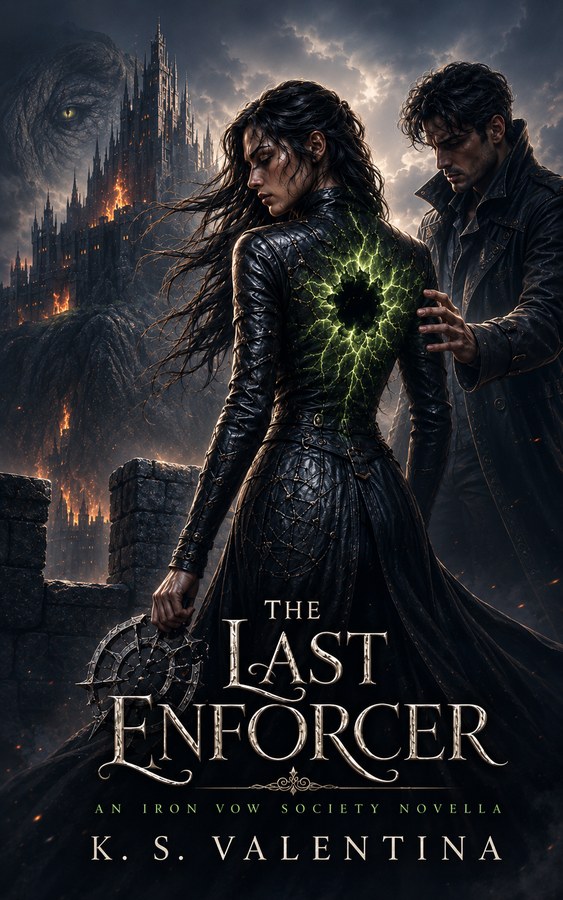
Cover Coming Soon
I'm going to put this somewhere they can't reach it.
That's the one thing my kind can do that no one has ever found a way to stop. We can't throw fire. We can't open a ward or call the dead or bend a ley-line into a blade. The world reached into us before we were born and took the magic out, and where everyone else carries their power, we carry a hole.
But a hole is not nothing.
A hole drinks. And what the drinking takes, it keeps—in the one place in all the world that nothing can be stolen from, because there is nothing there to steal.
So I'm going to fill mine with this. With him. With the whole of it, the cup and the green sky and the hand between my shoulder blades.
Then I'm going to send it down the dark to you—whoever you are, however far down the line you're standing when it finally reaches you. You have my nothing in your chest. I can feel the shape of you from here, the way you feel a stair in the black with your foot before your eyes agree it's there.
Someone should have told me what the nothing was for before I had to learn it on a wall with an army inside me. Let me be the one who tells you.
We owe each other that much, you and I. We are, the two of us, the only people who have ever been this alone.
It starts three days before the end, on the spine.
The ley-spine ran the height of the Silver Keep, a rib of granite that carried the mountain's power up from the deep stone to the warding-halls. Every stone in the Keep hummed with it if you knew how to listen. The spine sang.
I had my palms flat against it, and I was leaking.
"You're taking too much," Sorin said.
"I haven't taken anything yet."
"You're leaking. Same thing, three minutes from now."
He came up the spine behind me without hurrying—he never hurried, it was the most maddening thing about him and the thing that kept me alive—and set his hand flat between my shoulder blades, over the place where the void sat closest to the skin.
"Go slow. I've got you."
I went slow. I never go slow. But I tried, for him, because trying was a thing I did for him and almost no one else.
The ley-line ran under my hands like a river you could feel and not see, and the hole in my chest cracked open the way it always did near that much raw power—greedy, reflexive, drinking the current up off the stone because drinking is the only prayer it knows.
The power came up through my palms and into the nothing, and the nothing wanted all of it. Wanted the whole mountain. Wanted to keep drinking until there was no river left and no me left either.
And Sorin's hand on my back was where it went instead.
That's the thing I have to make you understand, because everything that happened on the wall happened because of it. An anchor is not a shield. He doesn't stop the flood. He stands in it.
The overflow the void can't hold bleeds out of me and into him and down through him into the deep stone, where it can do no harm—a wheel turning, stone to me, me to him, him to stone.
Without him the void fills and then, full, it reaches for the nearest living thing to keep emptying into, and the nearest living thing is always me.
A void left alone doesn't spare its own vessel. It eats her to fill the gap.
That is how every one of us has ever died, every Null who ever stood on a spine without a hand on her back.
His hand was warm through my coat. Warm is the wrong word. He felt like a floor felt—the thing under you that you never thank until it's gone.
I let the current cut out and pulled my hands off the rock, and the void sat in me fat and quiet. Sorin bled the last of it down into the mountain until the humming stopped and I was only a woman standing on cold granite with a man's hand on her spine, neither of us in any rush about that last part.
"There," he said.
"Show-off."
"That's rich, from you."
He took his hand back, finally, and I felt the cold come into the place where it had been.
He'd already turned to the arrow-slit and the long view east, and he had his chipped cup in his other hand—he carried it everywhere, a stupid glazed thing with a bite out of the rim that he would not replace, that he'd had longer than he'd had me.
He drank his cold tea out of it and looked at the sky like a man reading a letter he already knew the worst of.
The eastern range had a green in it that hadn't been there a week ago. Not the green of the forest. A bruise-green, a wrongness in the high air, the color the sky goes when the Fae move a war under it.
"Three days," Sorin said. "The scouts are saying three days. Twelve."
Twelve war-mages.
I'd taken three at once at the river-crossing and it had put me on my knees. It had cost him two days of slow bleeding to draw the recoil out of me after, hour by hour, while my own nothing tried to swallow me from the floor up.
Three had very nearly finished the both of us.
I looked at the green sky and the hole in my chest looked at it too—hungry, stupid, already reaching for it, because it is hungry for anything that burns and it has no sense at all about what will burn it.
"After this one," Sorin said, "we're done."
I didn't answer. We'd had this argument as a tender thing and a sharp thing and every shape in between.
"I mean it this time. We hold the wall, we drink their war, the Wardens give us the field—and then we put the pair down and we go east, past the green, past all of it, somewhere the word Enforcer doesn't mean a weapon they keep on a shelf."
He turned the cup in his hand, thumb worrying the chipped place as if it were a thing he could smooth by wanting.
"We've earned done, Vael. Both of us. I want to grow something that isn't a wall. I want a year where the only thing your nothing has to hold is me."
"You're a romantic," I said, "for a man whose whole job is being heavy."
"I'm the best anchor on this spine."
"You're the only anchor on this spine who'll put up with me."
"That," he said, "is the one I said."
And he smiled at the green sky like it was nothing, and the void took the smile and kept it, the way it kept everything, in the place that nothing can be stolen from.
I didn't know it was one of the last I'd put away while he was alive to give it. You never know which one is the last. That's the mercy in it and the whole of the cruelty.
Below us—far below the spine, below the dungeons and the founding-stone, deeper than anything the Wardens admitted was down there—something the size of the mountain turned over in the dark and went still.
I felt it come up through the soles of my boots. One slow pulse in the bedrock, there and gone, like a heart too old and too large to bother waking for the likes of me.
The Naga.
The Wardens swore it was a story they told to keep apprentices off the lower stairs. I'd felt it through the stone since the first day I came to the Keep—the one thing on the mountain older than the war, the only silence I had never learned to read.
It had never spoken to me.
It had never needed to.
In three days I was going to go down into that dark and ask it to save us.
It already knew it was going to tell me no.
I think it had known for a thousand years. I think that's why it pulsed—not to greet me. To start being sorry early.
A Warden put a number on me at the war-table that morning.
He didn't mean it as a cruelty. That was the worst of it. He read it off the way you'd read a depth off a cistern or a draw-weight off a ballista—Vael holds for the count of forty under sustained discharge—wrote it in his ledger, and went on to the next quantity.
I sat at the foot of the table and let him.
I had been a quantity so long it had stopped being an insult and become merely the weather.
Twelve war-mages, the scouts said. Two Enforcers to answer them: me, and Haldane's girl Sefa, who was good but young, whose anchor was a boy named Wren who had never grounded more than a single mage's discharge in his life and still flinched when she opened her void in front of him.
The Wardens spoke of percentages. They spoke of the eastern wall as a line on a map. They did not speak of Sefa or the boy at all, except as a fraction of the threat to be held at the south postern.
I did the arithmetic too. Mine came out different from theirs. Theirs ended with a held wall. Mine ended with a number too large to fit inside one woman and a man who would try to hold it anyway.
So that night I went down.
Past the dungeons, past the founding-stone, down stairs the apprentices were forbidden and the Wardens pretended led nowhere. The magelight in my hand thinned the deeper I went, the way light does when there's something below it that prefers the dark.
The air turned wet and mineral and old. The walls, which up in the Keep were dressed and squared, went rough and then strange—the same pale grey-white that no chisel had ever touched, the stone the mountain was before anyone decided to build on it.
I counted the turns at first. Thirty. Fifty. A hundred. Then I stopped counting, because counting is a way of believing an end is owed to you.
No end was owed to me. Not by the Wardens. Not by the mountain. Not by the thing under it.
The stair ended at water.
A still black pool lay in a cavern with no ceiling I could find, steam moving on the surface without wind, and the water warm in a way nothing that deep had any business being.
I did not see him arrive. I felt him—the pulse, closer now, no longer bothering to be small.
The surface of the pool moved, and a length of him rose out of it, and then more, and then more than I had braced for: emerald scales catching the dying magelight, a torso that was almost a man's lifting from coils thick as the pillars upstairs, jade eyes with the pupils stood up vertical and narrow, a forked tongue tasting the air above my head.
"A Null," he said.
The word came through the stone as much as the air, arriving in my teeth and the soles of my feet.
"It has been a long time since one of you came down my stairs."
"You know what I am."
"I know what you are before you know it yourself. I have heard your nothing since the day you walked into my mountain. It is loud, for a silence." The tongue flickered. "You did not come to be admired. Ask."
So I asked.
I told him about the twelve and the wall and the arithmetic that didn't close. I told him what he was: that the Keep stood on him, that the order I served had built its whole authority on the fact that the oldest thing in the world lay quiet beneath its foundation and let it.
I told him the truth I'd come down carrying: that his silence was not neutral.
By lying still under the Keep and calling it not my war, he gave the Keep its floor. He had been anchoring them for a thousand years and had simply never been asked to feel it.
"You're already on a side," I said. "You've been on it since they laid the first stone on your back. I'm not asking you to choose one. I'm telling you that you chose, and the choosing built the thing you say you don't take part in."
The cavern was quiet a long time. The waterfalls somewhere. The steam.
"You are right," he said at last, and I felt the words go down into the rock and come back. "That is the cruelty of being asked. The asker is so often right."
The great head tilted.
"And I will still tell you no."
"Why?"
"Because I have watched orders rise and drown for longer than your bloodline has had a name, and I have learned that the stone outlasts whoever is standing on it. The only way the stone outlasts them is by not caring which of them stands."
The tongue tasted the space between us.
"If I fight your war, I will win it, and then I will be a thing that wins wars, and they will build the next thousand years on that. You want me to be a wall. I have been a wall. A wall is a thing they put their backs to and then forget to thank, and then resent, and then chain."
"No, little Null. I will not fight for you."
I had known he would say it. It still went into the void with everything else, and the void kept it, cold.
I turned to go.
"Wait," he said.
I waited.
"Speak again. Anything. I want to hear the note."
I didn't understand, but I was tired and past pride, so I said the only thing in my head, which was the old soldier's count we used on the spine, the rhythm Sorin set his breathing to when he grounded me—three in, hold, three out.
I said it without thinking about the words.
The Naga went very still.
The vertical pupils widened, and that, I would learn, was the only thing his face ever did that meant afraid.
"Where did you learn those words?"
"They're just counting. Every Enforcer pair —"
"They are not just counting."
Something had come into his voice that hadn't been there for the refusal, something with a crack down the middle of it.
"That is the old language. The one that runs in the stone. It is older than your order, older than the Fae you are about to fight, older than the first Null who ever drank a ley-line."
His tongue stopped.
"No one has spoken it to me in..." He did not finish. "I do not have the number. And you spoke it without knowing you held it. The way you hold everything."
The great head lowered until the jade eyes were level with mine.
"Your nothing did not learn that. It remembers it. Do you understand what that means?"
"No," I said.
"Neither do I."
And then the mountain answered me.
I have to tell you about this part carefully, because it is the first time it happened and it will happen to you too. When it does, I don't want you to be as frightened as I was.
He spoke a word back to me in the old language—one word, low, the sound going into the stone and not the air.
The stone took it and carried it down into the deep rock and then up again, into the soles of my feet, into the bones of my legs, into the hollow place in my chest.
And the void, which drinks everything and gives back nothing, answered.
Not by drinking.
By recognizing.
For one breath I felt a line standing behind me in the dark—not ghosts, not memory, something stranger. A row of women I had never met and would never meet, each of them carrying my exact nothing, stretching back past the first stone and forward past the last.
Every one of them turned, in that breath, to look at me.
And then past them, far down the forward dark, one more.
The last in the line.
Standing so far ahead of me that she hadn't been born and wouldn't be for a thousand years and more.
You.
That was the first time I felt you.
You were a long way off, and you were already so alone, and the void in me reached toward the place where you would be as it reached toward anything that burned—except this didn't burn.
This was the opposite of burning.
This was the one warm thing the nothing had ever found that it did not want to eat.
"What was that," I said, when I could.
"That," said the oldest thing in the world, "is what your silence is for. And I do not think your order knows."
The jade eyes held mine.
"I do not think they would let you live if they did."
"Go back up your stairs, little Null. Hold your wall. I will not help you."
A pause, and the crack in the voice widened by a hair.
"But I find that I am sorry. I have not been sorry in a very long time. I had thought I was past it."
I went up the stairs in the thinning dark, and behind me the mountain pulsed once, slow, and then again.
I understood, the way you understand a thing in your spine before your mind will say it, that it had begun grieving me three days early, and that it would not stop for a very long time.
The night before the green sky reached us, Sorin made tea neither of us drank.
We shut the door of the narrow Enforcer's cell that had never been built for two, and for a few hours we pretended the war was a rumor about other people.
The chipped cup went on the sill where it always went.
I had asked him once why he wouldn't replace a cup with a bite out of the rim, and he'd looked at me like I'd asked why he wouldn't replace his own hand. He said his mother drank from it, and his mother's mother, and that a thing that has held what you love is worth more cracked than a perfect thing that has held nothing.
I thought it sentimental at the time.
I have since spent eternity inside the truth of it.
"Tell me the east again," I said.
We were on the narrow bunk, his back to the cold wall, me between his knees with my spine against his chest. He had two fingers at my wrist because he could not help it—an anchor's whole body is a habit of reading the vessel, and Sorin read mine in his sleep.
So he told me the east.
He was specific about it, which was how I knew he'd been building it in his head for months, stone by stone, the way other men whittle.
A house low to the ground with a long roof and a deep porch, on the lee side of a hill so the winter came off our backs. A stream close enough to hear. A fig tree, he said—he wanted a fig tree, of all the things to want.
He wanted to put a cutting in the ground and stay in one place long enough to eat from it, which for an Enforcer is the most outrageous ambition there is, because we do not stay anywhere long enough to eat from anything we plant.
He wanted a year.
He always said a year as though a year were a wild and greedy thing to ask for, and the worst of it—the part I cannot forgive the world for—is that it was.
He wanted so little. A roof, a stream, a fig tree, and a single year in which my nothing had one task, which was to hold him, and his hands had one task, which was to grow a thing that wasn't a weapon and wasn't a wall.
"You'd be bored inside a month," I said, because it was easier than the other thing.
"I'd be bored," he agreed, "and I'd have you, and bored-with-you is a thing I have never once gotten to be."
His mouth was at my temple.
"I'm cashing it in, Vael. After this wall. I've already told the Warden. I'm not asking you to come. I'm telling you there's going to be a fig tree, and a stream you can hear from the bed, and a man on the porch who used to be the best anchor on the spine, and if you don't show up he's going to be very put out."
"And if it goes wrong tomorrow."
"It won't."
"If it does."
I turned in his arms so I could see him, because some things you have to say to a face.
"If they're stronger than twelve. If I take more than you can carry. You let it go, Sorin. You hear me. You let the void take the wall instead of you. You don't take it to the bone."
"Mm," he said.
"That's not a promise."
"Mm," he said again.
That was the sound he made when he was agreeing with the words and lying about the meaning. I knew the sound. I knew it the way I knew his pulse and his breathing and the bite out of the cup, and I should have made him say the true words and I didn't.
Because his hand had come up to the side of my face, and his thumb was at the corner of my mouth, and he was looking at me the way he only looked at me with the door shut and the war pretended away.
Like I was not a quantity. Not a cistern. Not the thing the Wardens kept on a shelf.
Like I was the fig tree.
The thing he'd stay in one place to grow.
"Stop talking about the wall," he said, "and let me have the night."
So I let him have the night.
He kissed me slow, the way he did everything, the way that had maddened me for years and undone me for just as long—no hurry in him, none, as though we had every year he'd ever asked for instead of the hours we actually had.
His hands came under the hem of my shirt and spread flat against my back, against the place over the spine where in daylight he stood in my flood and bled it into the stone.
The difference between that touch and this one was the whole difference between us and everyone else. In daylight his hands had a job. Tonight they had one task, and the task was me.
The void in my chest—which spends every waking hour wanting, drinking, reaching for anything with heat in it—went quiet under his palms in a way it never went quiet for anything else in the world.
He was the one thing it didn't want to consume.
He was the one thing it wanted to keep.
I got his shirt off him and put my mouth to the old anchor-scars across his chest, the silver burn-lines where a decade of grounding my recoil had marked him, and he made a sound low in his throat and his hand fisted in my hair.
I pushed him back against the wall and he let me, all that patient strength going easy under my hands.
"Vael," he said, rough.
It was almost the vocative beat, almost the spine-voice—I'm about to say something serious—except what was serious was just my name, just the wanting in it.
I straddled him on the narrow bunk, and he gripped my hips and held me there a breath above him, his forehead against mine, both of us breathing the same air.
Then I sank down onto him slow, and we both made the sound people make when a long ache finally gets answered.
He filled me and the void went wide and warm, drinking nothing, taking nothing, only holding—holding him, the heat of him, the stretch and the press of him.
For once in my life the nothing in my chest and the rest of me wanted exactly the same thing.
He let me set it. He always let me set it.
His hands were on my hips and his mouth was on my throat and he let me ride him slow and then not slow, my hands braced on his scarred chest, his breath breaking apart under me.
When I shook he held me through it the way he held me through everything, steady, present, there.
And when he followed me over he said my name again, just my name, like it was the only word the old language had ever needed.
After, I lay along the length of him with his heart going slow and deep under my ear and his fingers tracing idle lines down my spine, over the place where the void slept.
Neither of us said anything about tomorrow.
The cup sat on the sill, and the void kept all of it. The slow start and the broken breath and the weight of his hand and the fig tree he was never going to eat from.
It keeps it still.
I have it here. I am sending it to you with the rest, and I want you to have this part especially, because I need you to know before I tell you how it ended:
There was a night.
It was good.
We were happy in it.
And no part of what came after can reach back and unmake it, because I put it in the one room the world cannot break into, and the door of that room is the thing I am handing you now.
That is the first thing the nothing is for. Not drinking armies. This.
Remember it when you get to your own hard part. There is always a room they cannot reach, and you carry it in the middle of your chest, and a dead woman a thousand years gone is the proof.
I am speaking to you from inside it.
Listen to how warm it still is.
Outside the slit window the dark had already begun thinning toward gray.
The cup sat on the sill.
Three floors down a horn started up, low and flat, sounding the muster, and Sorin's hand went still against my spine, and the night was over.
They came at dawn, under a sky the color of a wound going bad.
I had felt the Keep brace for it all night through the soles of my feet—the wards drawn up tight, the Wardens moving men onto the walls, the deep-stone wards thrumming as they took the load.
By the gray hour the whole mountain was leaning into the east like a body braced for a blow, and the green came down the range and pooled against the wards.
Where it touched them, they screamed: thin and high and wet, the sound of rope under more weight than rope can hold.
There is no arithmetic on a Warden's table that prepares you for the sound of twelve war-mages moving as one body. The air itself goes under pressure. A hum below hearing climbs into your fillings and the wet of your eyes.
Birds had left the mountain in the night, all of them, every one—the first time I'd ever seen a sky over the Keep with nothing alive in it.
Even the Fae's own crows had gone.
When the things that eat carrion will not stay to watch, you know what's coming.
The Wardens set their pieces.
Me on the spine at the eastern wall, where the breach would come. The eastern wall was the lowest and the oldest and the place twelve mages would choose, and I knew it and they knew it and the Fae knew it. So that was where we would all of us meet.
Sefa and her boy Wren went to the south postern with a third of the threat, four mages by the scouts' last count, which was more than that child had ever grounded. We all knew it. No one said it.
I caught Sefa's eye across the muster-yard as we split.
She was twenty. Her anchor was younger. She lifted her chin at me the way the young do when they want the old hand to think they aren't afraid, and I gave her back the only true thing I had, which was a nod.
I would not lie to her on the last morning and tell her it would be all right.
"Hold the boy close," I told her. "Closer than the drills. When it comes faster than you've trained for—and it will come faster—don't reach for the magic. Reach for his hand. The hand is the wall. Everything else is just stone."
"Yes, Enforcer," she said.
Wren looked at me over her shoulder, white around the mouth, one hand already half-lifted toward her back as if he could feel the future trying to pull him there.
I wanted to tell him something too. Something useful. Something that would make a boy into an anchor before the green sky reached him.
There was nothing.
So Sefa went south with her child behind her, and I never spoke to her again.
Sorin set his back against the granite of the eastern wall and his hand against my spine and his mouth against my ear.
"Slow," he said.
"There's no slow today."
"Then fast, and I keep up. I always keep up."
His fingers found the place over the void, and his other hand—I felt it—set the chipped cup down in a notch of the wall, out of the way. Where it would be safe. Where he could pick it up after.
The cup looked absurd there, small and brown against the war-stone, with the green sky pressing down on all of us. A domestic thing. A kitchen thing. The kind of thing that belonged beside a stream, on a porch, under the shade of a fig tree that did not exist.
I almost told him to move it.
I almost told him not to make promises with objects the world could break.
Then the eastern wards shrieked again, and the air went flat and bright, and there was no time left in which to be afraid gently.
"I've got you, Vael," Sorin said. "I've got you. Drink your war."
I put my palms flat to the wall and opened the nothing.
The first war-mage's fire came down on the eastern wall like the sky deciding to end.
And I drank it.
You cannot imagine it and I will not insult the truth by pretending I can make you.
Twelve is not three. Twelve is not three four times over. Twelve is an ocean where three was a river, and I stood in the surf of it with my hole open wide and pulled.
The first came as fire and I took the fire, and it was almost easy, the way the first of anything is almost easy.
The second came as the gray rot-light they use to kill the thing inside the armor without scratching the armor, and I took that too, and it tasted of meat left out in summer.
The third was a ley-working, slow and grinding, the kind that brings a wall down by convincing the stone it is tired of standing. The void drank the tiredness and gave it nowhere to land, and Sorin bled it down into the mountain, and my knees wanted the ground.
He did not let me have the ground.
His hand pressed flat over the void and he said the count into my ear—three in, hold, three out, the old soldier's rhythm, the one I'd said in the deep dark two nights gone and watched the oldest thing in the world go still to hear.
He didn't know it was the old language. He'd been saying it to me for ten years and never known he was speaking the tongue that runs in the stone.
He only knew it kept me on my feet, so he said it, over and over, his mouth at my ear and an army coming down on us both: three in, hold, three out.
The mountain under us heard him say it. I felt the rock answer the way it had answered me below, a deep slow recognition under everything, the bedrock leaning in to listen to a man teaching a dying language to a woman it was about to take.
The fourth and the fifth came together.
The fifth had a Fae cleverness in it, a working that hunts for the soft place in a defender and pours itself there. There is no soft place in a Null. There is only the hole, and the hole drank it laughing.
The sixth came, and by the sixth the wheel was turning so fast I felt it scream—a vibration in the granite that ran up through my palms and his hand and into both our teeth.
The void was past full, past anything I'd known a body could hold, fat and straining and still drinking because drinking is the only thing it knows and it does not know the word enough.
And in the middle of it, with six war-mages' fire inside me and the seventh opening its hands, the void did the thing it does.
It surfaced something it kept.
It always surfaces the wrong thing at the wrong time, the nothing. It has no sense of an occasion. What it gave me, there on the wall with the world ending, was the fig tree.
The low house and the stream you could hear from the bed and a man on a porch who used to be the best anchor on the spine, put out that I hadn't shown up.
One clean breath of the thing we were never going to have, surfacing through an ocean of borrowed fire.
I think the void meant it as a kindness. I think it wanted me to have the warm thing once more while there was still a me to have it.
I have wondered, since, whether it already knew.
Then the fire took the breath under, and there was only the drinking.
Six. Then more than six.
The Fae on the field saw that the eastern wall was not falling and did the sensible thing, which was to stop trying to break the wall and start trying to break me.
They turned their fire off the granite and onto the woman drinking it, and the difference is that a wall does not feel it.
The seventh hit like a blade under the ribs.
The eighth came braided with the ninth, two colors of killing twisted into one rope, and the void took the braid and opened wider than I had ever felt it open.
Behind me, Sorin made one sound. Not pain. Surprise, almost. As if some private measure inside him had just broken and he was annoyed to find it there.
And under all of it, far across the field to the south, I felt the other wheel stop.
I knew what it was before my mind would say it.
A pressure-drop in the world.
The particular silence—no.
The silence that is not the absence of sound but the absence of a hand.
Sefa's boy Wren had taken one pull too many, four mages' worth into a body that had never grounded more than one, and he had gone down.
Across the whole screaming field I felt Sefa's void open onto nothing, felt it fill and reach and find no anchor, felt it turn on the only thing left to turn on.
She shattered the way we all shatter alone.
For half a breath the south sky went white with a child's whole life going out unspent. Then it was dark again, and there were two fewer of us in the world.
I understood with a clarity that has never once left me in eleven hundred years that I was watching the next ten minutes of my own life happen to someone else first.
"Sefa's gone," I got out. "The boy fell and Sefa's —"
"I know."
Sorin's voice was already wrong, already thin.
"I know. Keep drinking. Don't you stop. I'm not Wren. I don't fall."
But I felt him starting to.
The way you feel weather change before the weather. The pressure dropping in his hand.
"Let it go," I screamed over the war. "Sorin, it's too much, you saw what happened to the boy, let the wall take it —"
"I've got you," he said.
There was no slow left in him, no patience, just the thin terrible effort of a man pouring himself out faster than a man can be poured.
I understood he was past the place where he could have let go even if he'd meant to.
He had taken so much into himself to keep it off me that he had become the floor, and floors do not get to step aside.
He had lied on the spine three days ago, and lied in the bunk last night with his thumb at the corner of my mouth, and now he was making the lie true with his whole body.
Taking it down to the bone exactly as he'd promised and exactly as I'd begged him not to.
"You're killing yourself —"
"That's allowed," he said.
Almost gentle. Almost the porch and the cup and the fig tree.
Then he took the next wave, and the next, and I felt him pouring the last of himself into the stone along with the recoil.
At the end, an anchor cannot tell where his own life stops and the overflow begins, and Sorin had never once in his life been able to find that line where I was concerned.
Eleven mages' worth of fire was in me.
The twelfth opened its hands.
And the hand on my spine—the floor, the only wall that ever counted—took one wave too many, and gave the last of himself to the stone to keep it off me, and fell.
There is a silence that is not the absence of sound.
It is the absence of a hand.
I felt him go before he hit the granite.
The wheel stopped—stone to me, me to him, and then no him, the circuit open, the floor gone out from under the flood.
One instant his palm was the whole architecture of my survival, and the next there was only my back and the cold air and twelve war-mages' worth of fire with nowhere left to bleed.
I went down on my knees on the spine.
I got my hands on him.
His eyes were open, and there was nothing behind them but the after-image of a man who had spent every part of himself on a single task and finished it well.
He had carried it to the bone. He had told me he would, on the spine and in the bunk, and I had let him lie because I wanted the lie more than the argument.
Now the lie lay under my hands with its eyes open, having been, to the very last, the only thing it was ever for.
The void in me was full and rising.
It had finished filling, and now it wanted out, and there was no anchor in the world to take the out.
I had just watched the same arithmetic kill a child to the south not three minutes gone, and so the void turned, the way it always turns, the way it had turned on Sefa, toward the nearest living thing.
Me.
I knelt on the spine with my dead anchor under my hands and an army inside my chest and felt my own nothing begin, very patiently, very completely, to consume me from the soles of my feet up.
I had minutes. Less.
The void does not grieve and it does not wait. It only fills, and empties, and fills.
I could have let it.
I want you to know that I thought about it, in the place where thoughts go that fast, faster than fire. I could have knelt there with his eyes open under my hands and let the void take me and let the fire die in me unspent.
The eastern wall would fall to the twelfth mage and the Keep with it, and the Wardens who counted me as a cistern would learn at last what a cistern costs when you finally crack it.
I could have followed him down.
He was right there. He was still warm.
There was a version of me kneeling on that spine—and I need you to know she was real, she was as real as the one who stood up, she has never entirely stopped kneeling—who wanted nothing in all the world but to lie down on the cold granite beside him and follow him into the dark and let the whole screaming order burn.
But you were at the end of the line.
I couldn't see you yet.
But I'd felt the place where you would be, two nights gone, in the deep dark with the old language in my mouth—that far-off warm thing the void didn't want to eat, the last woman standing in a row that hadn't been born.
You were there.
You were already so alone.
And a woman with an army in her chest and the warmest thing she owns going cold under her hands does not, it turns out, get to follow anyone anywhere.
She gets one more thing to do.
And then—only then—she gets to rest.
I took my hands off him.
That was the hardest thing.
Not the dying. The dying was easy; the dying was almost a mercy.
The hardest thing I have ever done in this life or the long strange half-life after it was lifting my two hands off the chest of the man who had been my floor, and leaving him on the granite with his eyes open, so that my hands would be free to do the last thing right.
For one breath, the war seemed to hold itself away from me. The green sky, the screaming wards, the twelfth mage gathering its hands. Sorin on the stone. My palms empty.
Then the breath ended.
I stood up on the eastern wall, alone, the last Enforcer with no anchor left in the world, and I turned the nothing around.
I put my hands on the granite over the breach.
Over the place where the twelve had massed their assault, where the eastern wall was already failing, where the twelfth mage stood with his hands open and his war-host packed into the gap behind him.
Certain, the way the powerful are always certain, that the woman on the wall was finished.
And then I did the thing they never tell a Null.
The thing the Naga told me too late, the thing the books got wrong because the books were written by people who watched us die from a safe distance.
The void is not only a mouth.
It is a lens.
What it drinks, it can give back—not as a flood but as a beam, all of it compressed through the density of the silence itself.
A mirror that does not merely reflect the light but presses it into a single edge.
I had twelve war-mages' worth of fire inside me and no anchor to bleed the recoil, which meant the giving-back would kill me as surely as the keeping would.
There is no version where the Null walks off the wall.
With an anchor, you drink and survive. Alone, you can drink, or you can give it back, and either way the void empties into you at the end.
The only choice left to me was where the fire went on its way out.
I chose the wall.
And I gave it back.
You have to understand what that is, from the inside, because no one who has done it has ever lived to say.
Drinking is easy. Drinking is letting a door stand open and a flood come through it; the void was built for drinking, it wants nothing else.
Giving back is the opposite of everything the nothing is.
It is taking an ocean you have already swallowed and refusing to let it scatter—closing the hand, narrowing the throat of the silence down and down until the fire has nowhere to spread.
Until every separate killing-light the twelve had thrown is pressed into the same single unbearable edge.
The density of the silence is the weapon.
The emptier you make yourself around the fire, the harder the fire comes out.
So I emptied.
I made myself a smaller and smaller nothing around a larger and larger everything, and the void screamed in a way it had never screamed at me before.
For the first time in my life I was using it for the thing it was actually made for.
And I felt, in that screaming, very far down the forward dark, the line of women lean in to watch.
You among them.
The last one.
I did it where you could see.
I wanted you to see it done right.
Then I opened the hand.
Eleven hundred years later they still have the word for it, though they've forgotten almost everything else: the Cascade.
They say I leveled the eastern wall.
That part is true.
I brought the Keep's own wall down, every stone of it, because the Fae were inside the breach and the only way to bury an army that has already broken your gate is to bring the gate down on top of it.
The fire went out of me through my hands and into the granite, and the granite became the weapon.
All that compressed, silence-pressed light detonated along the fault of the wall, and the eastern wall of the Silver Keep stood up off its foundation.
For one impossible breath the stones hung in the green dawn, every block lifted into the air as if the mountain had inhaled.
Then the wall came down on twelve war-mages and everything they'd brought, and the siege ended in a single sound that I felt in my teeth and the wet of my eyes and the floor of the world.
His cup went down with the wall.
He had set it in a notch of that eastern wall at dawn, out of the way, safe, to pick up after.
And I brought the eastern wall down with my own two hands, because that was the only way the war ended.
So I did not only bury twelve war-mages in that stone. I buried the one cracked thing he loved, the cup his mother drank from and her mother before her, the thing he kept broken because a thing that has held what you love is worth more than a whole thing that has held nothing.
He was right about the cup.
He was right about everything except the one thing, which was that he could carry it.
And I was the hand that brought the wall down on the last of him.
Remember that, when someone offers you a clean choice.
There is no clean choice.
There is only the wall, and what you are willing to bring down with it.
And then the void was empty.
And empty, it did what empty always does.
It reached for the nearest living thing to fill itself, and the nearest living thing—the only living thing left on that spine—was me.
I felt it start to take me. From the floor up, patient, complete, the silence consuming its own vessel because there was no one left to consume instead.
A void does not tolerate emptiness, not for an instant, not even to spare the woman who is it.
I went down on the broken wall.
And the mountain opened.
He came up through the stone—not the stairs, the stone itself, the bedrock parting like water.
All that emerald length poured up out of the deep dark where he had lain and refused me and been sorry early, and the jade eyes found me.
The great hand that was almost a man's hand closed around mine.
"I will not let you go alone," the oldest thing in the world said. "I would not fight your war. I find I cannot do this other thing—let you do this part with no hand in yours."
His grip tightened, careful and useless and real.
"It is all I have. It is not enough. I know that it is not enough."
It wasn't.
He was right.
He was not my anchor; he was not bonded to me; his hand could not ground a void that had already turned on its vessel, could not turn back the thing that was taking me.
A bond is a wheel and we had no wheel.
All his hand could do was be a hand.
But I want you to know—and this is important, this is one of the most important things I am sending you—that it was not nothing.
I did not die the way every Null before me died, the way Sefa had died not ten minutes gone, the way they all died: alone on a floor with the silence eating up from the soles of the feet and no warmth anywhere in the world.
I died with a hand in mine.
It could not save me.
It was never going to save me.
But there is a difference between dying and dying held, and it is the whole difference.
It is the only difference that has ever mattered, and an order that counted me as a cistern never understood that the difference is the entire point.
"Stay," I said, in the old language, without deciding to, because the nothing remembered it.
Stay.
"Always," said the Naga, which is not a word his kind gives, which he had perhaps never given to anything in three thousand years.
"Always. I am not going anywhere. Take as long as you need. The mountain is not in a hurry. Neither am I."
And the void took me, from the floor up, and his hand stayed in mine the whole way, and the mountain began to shake.
They say the mountain shook for three days when I died.
It did. I was there for it, in the way you are present at your own ending—scattered, slowing, the I of me coming loose at the edges and going out into the silence one kept thing at a time. The Naga held my hand for all three days. He did not let go when I stopped being able to hold back. He did not let go when there was no longer a woman to hold, only a cooling weight and a void going wide and patient and empty. The stone shook with the size of what he would not say, and the Wardens upstairs thought it was the aftershock of the Cascade, and it was not. It was grief in the only language he had left, which was the language of the mountain, which is older than my order and older than the Fae and older than the first Null who ever drank a river.
And in those three days, while the I of me came loose, I did the last thing.
I had an emptied void and everything I had ever kept. The cup on the sill. The fig tree we never planted. His two fingers at my wrist and his I've got you and the weight of a hand that could not save me staying anyway. The slow start and the broken breath and the one good night with the door shut and the war pretended away. Every kindness I had ever swallowed because there was no other safe place to put it. The whole hoard of a life, gathered in the one room the world could not break into.
And I had felt, two nights before, in the deep dark, the place at the far end of the line where you would someday be.
So I did not let the void scatter what it held into nothing. I gathered it—all of it—and I pushed it down. Not into the air. Into the dark. Into the blood that did not exist yet, down the long unmade line of women who would carry my nothing after me, mother to daughter, absence to absence, each of them a void that keeps, each of them a room the world cannot reach. I pushed it down the line toward you, the way you press your palm to cold stone and feel the current answer, and I said the thing I most needed someone to have said to me, and I said it not into the air but through the void, so that it would never be lost, so that it would arrive in the one place nothing can be stolen from:
You are not a cistern. You are not a weapon they keep on a shelf. The nothing in your chest is not a lack. It is a room, and it is the safest room in the world, and the day they tell you it makes you alone, you remember that a dead woman a thousand years gone filled it up with everything good she ever had and sent it down to you so you would never have to be as alone as she was.
And when your war comes—and it will come, it always comes—do not let them put you on a wall without a hand in yours. I had one for a little while. It was the best thing I ever drank and the only thing worth keeping. Find yours. Find more than one, if the world will give them to you; be greedier than I was; let them hold you. The hand that holds you is the only wall that counts.
I am sending you everything. Hold it for me. I have to go now. There is a serpent holding my hand and a mountain shaking itself to pieces and I am not, in the end, afraid.
That was the last of me. I went into the silence with my hoard sent on ahead, lighter than any Null has ever gone, and the hand stayed in mine until there was no mine left for it to stay in.
❦
The mountain stilled on the third day.
The Naga went back down into the deep dark and the still black pool, and he did not come up again for a very long time. The Keep raised a new eastern wall over the rubble that had buried twelve war-mages, and the Wardens wrote the last recorded Cascade Reversal in their ledgers and the name Vael beside it, and then they set about making certain there would never be another Enforcer who could refuse them—that is a different story, the story of the inversion and the breeding programs and the iron vow they built on the ruin of everything I was. But it is not the story I am sending you. I am sending you the good night and the held hand. I am sending you the room they cannot reach. Keep it. It was always yours. It was always going to be yours.
❦
Eleven hundred years later, on the same mountain, under a different and crueler name, a serpent lay in the deep dark and felt a girl walk in through the gates above with a hole in her chest where her magic should have been.
He had felt that nothing before. Once. A thousand years and more ago, in a woman who was very brave and very loud, who had spoken the old language without knowing she held it, whose hand he had held while the Cascade tore her apart and the mountain shook for three days.
The girl above did not know what she carried. She thought it was a lack. She thought it made her alone.
The serpent rose through the warm black water and tasted the air, and for the first time since the wall came down, the old language had someone to answer.
There you are, he said, to the stone, to the water, to the nothing walking in above. I have been holding something for you. She left it with me. Come down when you are ready, little bird. Come down and I will tell you what your silence is for.
A Note from the Headmistress
For readers who have finished the novelette. Spoilers below — and the whole of the Iron Vow Society in a sentence.
Darlings,
You have just watched the first of them die.
Everyone who reads the Iron Vow Society wants to know where the void comes from—what a Null is, why the order built an academy on top of one bloodline and a sleeping serpent, why Scarlett Locke walks into a mountain that already knows her name. I have always known you would ask. So here is your answer, and I warn you it is not a kind one: the void you find so romantic in my Scarlett was forged on a wall, by a woman the order weighed like a cistern, who drank an army to save people who would have let her die unthanked.
Vael was the first. She was also, very nearly, the last—one of the bright branches before the tree began to die, before the inversion, before they bred the Enforcers down into something they could keep on a shelf. She died with one hand in hers, and one was not enough, and it has taken eleven hundred years and three monsters who refuse to let go for the line to get a daughter who survives what Vael did not.
That is the whole of the Iron Vow Society, if you want it in a sentence: the difference between one hand and three.
I told you danger has to earn its softness. Vael earned yours. Be gentle with her. She sent you everything she had.
— The Headmistress