KATE SEGER
BONE COVENANT
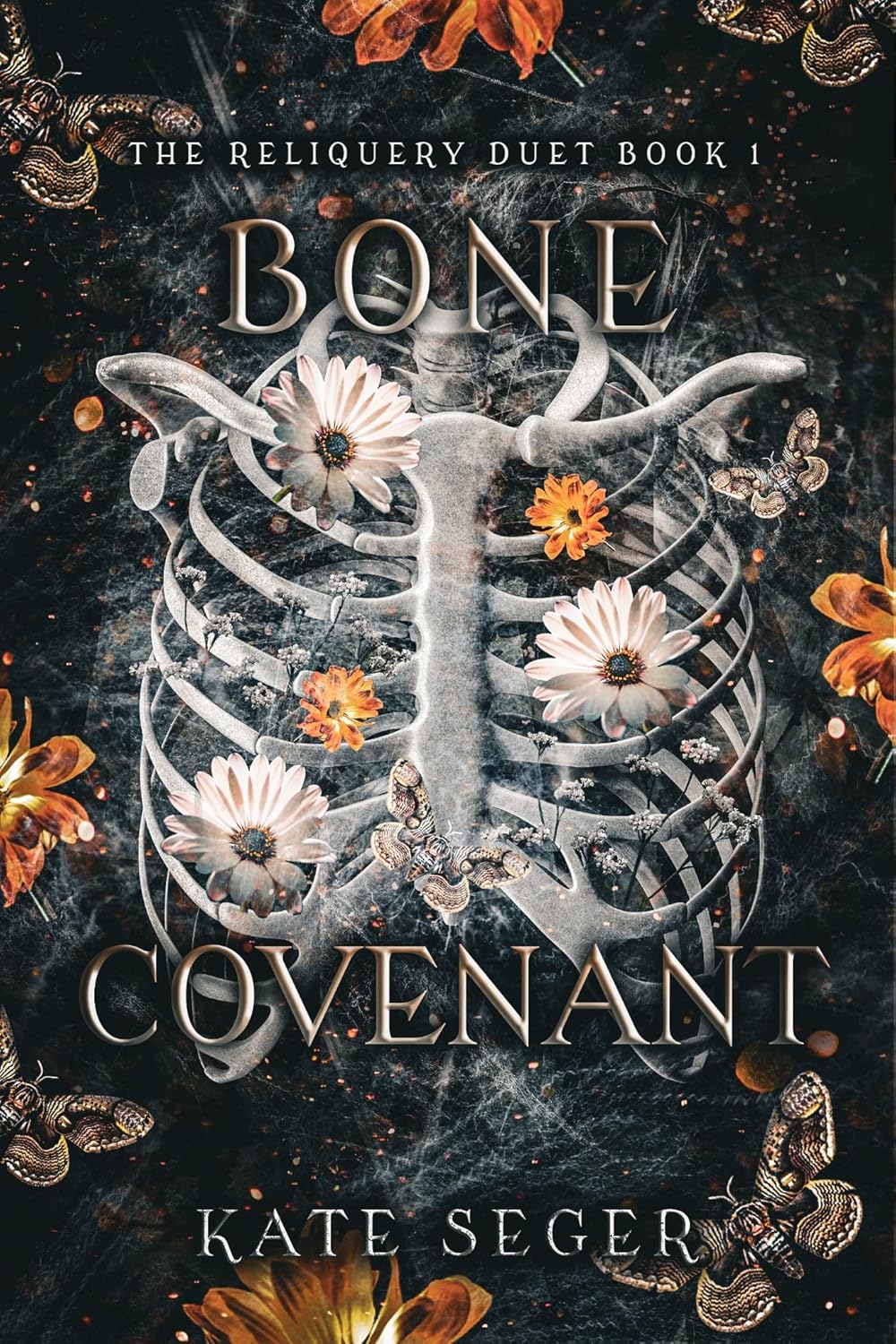
Ashenmere, October 1348. The Black Death has emptied the village of carts and pigs and children, and the bells of St. Cuthbert’s have learned a rhythm Else doesn’t want to count. Her mother is dead. The cottage is hers. The sick are hers. The cracked mortar her grandmother used is hers, and so is the tingling under her palm when she lays a hand on a man who is about to leave his body.
Father Aldric will not take the tisane she sent for his cough. The seven-year-old in her kitchen has stopped asking. And the thing her mother began to teach her, the night they sat beside Henry the harnessmaker’s apprentice, is starting to come due.
For the women who bled for the land and were erased from the record.
And for the ones who remembered them anyway.
A printable artifact — Else’s mother’s herbal recipes, charms, and marginal notes, in her own hand. The work the Church wouldn’t sanction. The work Eleanor passed on anyway.
Open the Receipt Book →A note from the cathedral
Bone Covenant is the book I have been trying to write since I was fourteen years old and learned that women like Eleanor existed and were not in any of the textbooks I was reading. She is not a real woman. She is a kind of woman the record refused to keep. I wanted to put her in.
Else is what comes after. The daughter holding the lamp. The work passing forward. The cracked mortar still grinding. Her book asked me harder questions than the duology before it — about what it costs to be the only one who knows when someone is leaving, and about what happens to the women who carry that knowledge alone.
And then, halfway through writing Else, The Beast Beneath the Bells arrived without warning. A different century, a different city, a different monster. I am still slightly winded from it. May 15. Cordelia Elliston, Sunder, the chained guardian, the sulfur-yellow fog. More on that further down.
The other thing in this dispatch is for those of you who have read Bone Covenant already and want to stay in Ashenmere a while longer. Below, you’ll find a scene that didn’t make the manuscript — the night Eleanor first taught Else what hands can know. And if you’d like to take Eleanor’s receipt book home with you, the link is up at the top.
Two more to come in the duet. The cathedral remembers the rest.
The Lesson
It was September the year I turned fourteen, and the old harnessmaker’s apprentice had come down with something nobody could name.
We’d been called late, after the priest and after the apothecary, the way we always were — Mam’s reputation in Ashenmere being what it was, which is to say, useful in private and never spoken of in public. He was twenty-three. His name was Henry. I had known him since I was small enough to ride on his shoulders to the millstream, and now I was holding the lamp while my mother set out her tools on a square of clean linen at the foot of his bed.
Linen. A wooden tray. The cracked mortar. Willow bark, comfrey, a small dark bottle Mam never let me open. Her hands moved through them in the order she always set them in — the order, she’d told me once, that her own mother had set them, and her mother’s mother, and back, and back, and back. We stack our hands on top of theirs, Else. That’s how she’d said it. That is how we don’t lose them.
Henry’s room was hot. The shutters had been closed for three days and the candles had been left unattended in a way that suggested the people who loved him had stopped believing the candles mattered. I propped the door open with my foot. Mam looked at me, then at the door. She didn’t say anything. She didn’t need to.
“Closer with the lamp.”
I came closer. I held the lamp at her shoulder, the way I had been holding lamps for her since I was tall enough to reach. The light caught the side of her face and showed me the white at her temples that I hadn’t noticed in the daytime and showed me the deep shadow at the hollow of her throat where her skin had begun to thin. She was forty-two that summer. She looked older.
“Look at his lips, love.”
I looked.
“Tell me what you see.”
His lips were grey. Not blue. Not white. Grey, the way ash is grey, with a thin film at the inner edge that I had no word for then.
“They’re — not the right color.”
“What color should they be?”
“Pink.”
“And what’s between pink and what’s there?”
I didn’t know.
She held her hand out, palm up, and waited. I shifted the lamp to my left hand and put my right into hers. Her fingers were warm and dry, lighter than they should have been. She turned my palm over and put it against Henry’s mouth, light as a moth. The skin under my hand was cool. Not the coolness of a man at rest. Something else. Something that had finished being warm.
“Stay,” Mam said. “Don’t lift it yet.”
I stayed.
I had imagined that what she was about to teach me would feel like a lesson — like the catechism, like the alphabet I had learned in the priest’s chair before he stopped having me come, words and rhythms I could repeat back to her until she said good, that’s right. I had imagined a sentence I would memorize.
What it was, was a pressure.
It was small, at first. The faintest suggestion of a draw, the way a pulled thread runs along the weave before it breaks. It was under my palm, and then it was under the heel of my hand, and then it was up into my wrist. I almost lifted my hand. Mam’s fingers closed over mine and held my hand in place.
“Stay.”
I stayed.
The pressure resolved itself into a direction. It was pulling — not toward me, not away from me, but past me. As if something in Henry that had been laid alongside the rest of him was beginning to ease itself out from under the weight, the way a person eases out from under a sleeping child. There was no violence in it. There was only the quiet, steady work of separation.
I made a sound. I didn’t mean to. It came out of my chest before I could decide whether to keep it.
Mam took my hand off Henry’s mouth. She set it on my own knee. She kept her fingers on my wrist a moment longer, the way you keep a hand on a horse that’s startled.
“There,” she said. “That. That is what I wanted you to feel.”
I looked at her. Her face was the same face she wore in the kitchen. The same face she wore to market. Whatever she had taught me had cost her nothing visible, and that was its own kind of teaching.
“Will he die?” I asked.
“Yes.”
“Tonight?”
“Likely.”
“Can you —”
“No.”
I waited for her to soften it. She didn’t. She picked up the comfrey poultice and unrolled the linen and began to apply the herbs to the swelling at the hollow of his collarbone. Her hands moved without hurry. She had worked many bodies that were not going to live.
“Mam.”
“Mm.”
“Then why are we doing this?”
She didn’t look at me. She pressed the poultice into place and tied the cloth with the small, neat knot she always made, the one she had taught me to make and that I still couldn’t manage without thinking about it.
“Because we are here, Else.”
I waited. There was always more.
“The herbs may help him sleep. The willow may quiet the heat. He will know he was tended to. His mother will know he was tended to. If there is any easing to be had, we will give him whatever measure of it we can.”
She looked at me then.
“That is the work. Not the saving. The saving is sometimes given to us and sometimes not. It is not the part we control. The part we control is whether we sit with the dying or leave them to die alone.”
I nodded. The lamp shook. I steadied it.
“And the feeling?”
She tied off the second poultice. She set the linen aside. She folded the unused herbs back into the cloth they’d come in, with the same care she would have used if Henry were going to recover and want them tomorrow.
“The feeling is the part nobody else can do for them. Most of the village will tell you their loved one is taking a turn or struggling or hanging on. They won’t know. They can’t know. You will. And when you know, Else, your job is not to tell them. Your job is to be ready for what comes after.”
“What comes after?”
“Cleaning the body. Making the broth for the people who loved him. Sitting on the step with the seven-year-old who doesn’t know yet. Walking home in the dark and not crying until you’re inside the door. Putting your hands in cold water at the basin so they won’t shake at supper. That is what comes after.”
She looked at me a long time.
“You’ll know the rest when you need to.”
I held the lamp. I held it because she had asked me to and because it was the thing I knew how to do. Henry breathed shallow and even. The grey at his lips deepened a fraction, the way the sky deepens before it commits.
Mam packed her tools. She wiped the cracked mortar with the corner of her apron and laid it on top of the cloth. She looked at me again, and this time something passed across her face that I did not have a name for yet — not pride, not grief, but a recognition, the kind of recognition a stonemason makes when she lays down a stone she has been carrying alone for a long while and finds someone else has come to take the other end.
“Come on,” she said. “We’ll stop at the Coopers’ on the way home.”
“His mother —”
“The neighbor will sit with her. We will come back at first light.”
We went out into the September dark. The bell at St. Cuthbert’s struck the hour. I had counted them since I was small enough to count with my fingers, and I counted now.
Eight.
Mam took my arm.
“Walk with me, love.”
We walked. The lamp swung between us. My hand still felt the pull of Henry’s mouth, the small steady draw of something getting up from the rest of him, the work of separation.
I have felt it many times since. I have felt it tonight.
I never told her how loud the world was, after.
That was the thing she didn’t teach me. That was the thing she could not. That was the part that came from doing the work after she was gone.
For more of Eleanor in her own hand, the receipt book is here.
Which Kate Seger world is yours?
Up next, in the yellow fog

On my nightstand
What I’ve been reading between drafts. If you finished Bone Covenant and need somewhere to land — start here.
Company of Liars
Black Death England, 1348 — nine strangers moving north to outrun the plague, each carrying a secret, one carrying something worse. Maitland writes like she’s lived in the 14th century. If you want to stay in Ashenmere’s world a little longer, this is the book.
Find it →Weyward
Three women across five centuries, each inheriting a magic the church couldn’t name and therefore tried to burn. Hart writes the knowledge that passes mother to daughter as something alive — the same thread Else holds in her hands.
Find it →A Secret History of Witches
Five generations of women, a bloodline of magic passed forward under duress, from a Breton forest to wartime Britain. The book understands that inheritance is both gift and cost. Louisa Morgan is very good at daughters.
Find it →The Gargoyle
A burn victim, a sculptress who insists she was his lover in 14th century Germany, and love stories from five different centuries woven through the frame. Davidson writes the past as something that won’t release its grip. Dark, Dante-inflected, completely uncategorizable.
Find it →