The Darkling Dispatch
Issue No. 03 · June 2026
Two doors are opening this summer.
One closes the duet that began with Bone Covenant. The other opens a duology I have been carrying quietly for a long time.
Friends. The first door is the one I have been promising. Bone Sacrament — the second and final book of the Reliquary Duet — releases June 15.
It is the resolution of what we began at Ashenmere. The work the bone women did with Eleanor's blood. The renewed covenant in the chapel. The fast horse south carrying the Bishop's letter to Rome. The thing that opened its eye at the end of Book One. All of that comes due in Bone Sacrament. The road runs out of Ashenmere, through January frost, all the way to Provence. The chapel above the village is not the only one with a foundation older than Rome.
I cried at the end of this book. I am going to be honest about that. Else and Callum's story does not resolve the way I thought it would when I drafted the outline two winters ago. Their story resolved itself. I wrote what they did. I think you will know what I mean when you get to the last chapter.
First Look — Callum
A character page from the Reliquary Duet. Spoilers for Bone Covenant; safe for Bone Sacrament.
Carries. A leather-wrapped roll of pens, one with the nib worn down nearly to nothing because he keeps using it past where any sensible scribe would. A small wooden box whose contents he has never named to anyone in the village. A copy of Augustine's Confessions with the margins inked half-to-death and the spine soft as a hand. The Bone Codex, half-finished. A flint and steel he has not used in years and does not throw away.
Voice tells. Slow to speak. The pause before he answers a question is not hesitation — it is the work of reading the question first. When he is arguing, he drops into Latin without noticing he has done it. Will not interrupt. Will wait. Will say the thing once, plainly, and let it sit. When he is moved he goes very still and very quiet, and the quiet is the giveaway.
Will not. Leave the room when Else is healing. Lie about what he knows. Use the word subject of anyone he loves (she taught him this; he learned). Pretend the Church does not still ache in him. Tell a story he has not verified.
What he smells like. Oak-gall ink, oat porridge, the wax of chapel candles. In summer, the dust of old paper warmed by sun. After a long day at the Codex, a faint sweetness from the gum arabic. Never incense. Not anymore.
Body in a room. Kneels when others stand. Hands clasped or holding a book. Reads with his right palm flat to the page when something has caught him. Sits at the corners of tables, not the centers. Stands behind Else when there is a stranger in the room, never in front of her — protective, not proprietary.
Sleeps. On his left side, facing her. Has done so since the night she let him.
One line he never says aloud. I would have come to you sooner if I had known I was allowed.
⁂
Bone Sacrament
June 15. Kindle, Kindle Unlimited, and paperback.
Pre-order NowThe second door is the new one.
I have been holding this for months. I am telling you now because the cover is finished and I cannot keep it to myself any longer, and because the release is closer than it feels: August 1.
The Sweating Year
Book One of The Hollow Crown Duology.
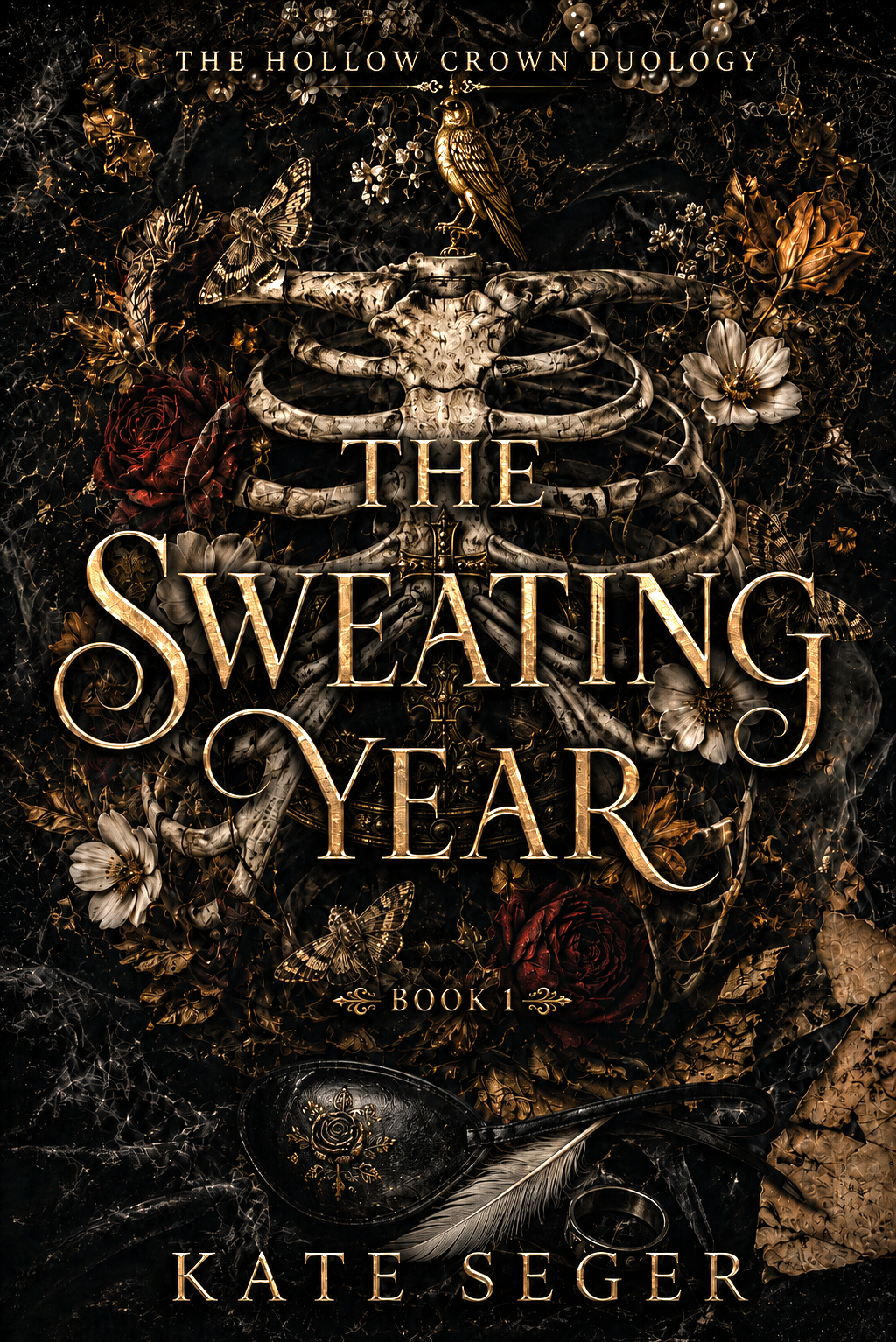
On the cover. The ribcage is the center because the body is the center of every Death story I will ever write. The raven sits above it because Death has many small servants and one of them does her a favor in Book Two. The candle at the lower left is the vigil candle — the candle the women keep burning in the chamber of someone who is going. The feather under the small dark bowl is the Devil's apology, and the bowl is not quite a bowl, and you will know what it is when you have read past the coronation.
It is 1528. The sweating sickness has come to Kent. Anne Boleyn lies in her chamber at Hever, soaked through, attended by women who do not know who has just come up the avenue in the dusk to claim her.
Anne does not die that night. The woman who came to take her stays at her bedside instead. The rule she has held for ten thousand years is broken, and the rest of the duology is what follows from a single quiet decision in a Kentish fever-room in June.
The Hollow Crown is historical fantasy romance. The same voice you know from Bone Covenant — sacramental, gothic, body-rooted, written in the cadence of a missal that bleeds. The setting is Henry VIII's court from the year of the sweat through Anne's coronation, into the years that end on a scaffold. The love is a triangle: Death, the man who is wearing the Devil, and the man through whom God reaches without his knowing.
I have wanted to write this book for a long time. Now I am writing it. I would like you to be there when it opens.
The Iron Ring
From the cosmology of The Hollow Crown Duology. Safe for everyone; spoils nothing.
The ring is iron. It is heavy enough to be noticed when worn and noticed more when not. It has no stone, no gem, no maker's mark. It bears, on the inside of the band, three small grooves whose meaning no one has ever explained to the woman who wears it. She has had it since before she knew she was the one who would have it.
It is the sigil of office. It binds her to the work of mercy in the British Isles — to the dying in every village and chamber and battlefield and birthing bed from the Hebrides to the Channel, from the year the stones at Avebury were raised to whatever year is the last one. While she wears it, she is the reaper. The body she walks in is a cover. The face she shows is borrowed. The work is the only thing in her that is hers.
It is also, she has been told once, a vow. By whom and to whom, she has never asked.
It runs cold against her finger when she has done the work as it should be done. It runs colder when she has not. It has not gone warm since a year that did not yet have a number, when a herd of cattle drowned in a fen near the place that would one day be called Cambridge, and she was very young, and a woman in a coracle looked at her and said, take the ring, child, before it asks too much of you, and she did not.
It can be removed.
She does not know that it can be removed. She believes the binding is mortal in shape — that the ring goes off her finger only when the finger goes off the bone. She is wrong about this. It is, in truth, a willing vow. It was always willing. The work was never imposed. The mercy is hers because she has chosen, for ten thousand years, to be the one who carries it. The ring stays on because she does not yet know she has been choosing.
One being has touched it. One. In a small chapel at Leicester Abbey, on the night a cardinal of the English church died of grief and a small fever and a long failure of nerve, a man with one eye and a leather patch put his hand over hers where the ring sits. He has loved her for ten thousand years. He has wanted, for most of them, to ease the weight of what she carries. He is the only one who has understood that he could not — that to ease it would be to ask her to be something other than what she has chosen — and so he has stayed, and waited, and put his hand over hers without taking the ring off, because she did not ask him to.
She has not taken the ring off either.
Yet.
⁂
The Sweating Year
August 1. Available for pre-order now.
Pre-order NowThank you, as always, for being here.
— Kate